Is vaping more expensive than smoking? A cost fact check
Is vaping really more expensive than smoking – or does it just seem that way because of the confusing hardware, pods, and "puff" figures? This fact check is aimed at price-conscious smokers who want a clear cost breakdown before seriously considering switching to e-cigarettes.
1. Framework conditions: What is actually allowed for an e-cigarette in Germany?
Before we get into specific euro amounts, it's worth taking a quick look at the rules of the game. These determine which devices and e-liquids are legal in this country – and therefore what you can reliably compare.
1.1 Legal limits: Nicotine, fill quantity, “giant disposables”
The European Tobacco Products Directive (TPD2) sets clear upper limits for e-cigarettes. According to EU TPD The maximum permissible amount of nicotine liquid in refill containers and pods is 20 mg/ml included; at the same time, the fill quantity of disposable devices and pods is on 2 ml limited. These guidelines apply to all reputable products on the German market.
The Federal Ministry of Food and Agriculture implements these rules in Germany. Tobacco Products Act (TabakerzG) um. It states, among other things, that:
- Refill containers and cartridges must not contain more than 2 ml,
- certain additives are prohibited
- The free distribution of nicotine-containing e-cigarettes is not permitted.
Devices with extremely high capacities (for example, so-called "5,000-
1.2 Taxes as a cost driver: Why e-liquids have become more expensive
Since 2022, e-cigarette liquids have been subject to special taxation in Germany. The legal basis can be found in the... Tobacco Tax Act (TabakStG). A tax path is defined there, according to which the tax per milliliter of liquid increases gradually – starting at 0,16 €/ml and later until 0,32 €/ml.
For you, this means that part of the price of every legally sold disposable e-cigarette or e-liquid consists of taxes. Offers from dubious sources are often cheaper because they circumvent these taxes – with corresponding legal risks (more on that later).
2. How much "performance" do I get from a cigarette, a disposable cigarette, a pod cigarette?
To compare costs fairly, A common unit is needed. In practice, two approaches have proven successful:
- Cigarettes/Amount of smoke per day
puffs (Puffs) or liquid consumed per day
2.1 Puff and volume heuristics from practice
Experienced traders and those switching systems use simple rules of thumb to estimate consumption:
-
Mouth-to-Lung (MTL)-Devices (typical draw resembles a cigarette): approximately 50–150
puffs per ml. -
Direct-Lung (DL)-Setups (more open airflow, large clouds): approximately 30–80
puffs per ml. - Manufacturer specifications such as "800
puffs “These are more like lab results.” Realistically, you should expect 60–80% The specified number of puffs should be calculated based on the duration of the draw and the temperature.
These ranges explain why two people experience very different battery life with the same e-cigarette. Those who use it for particularly long periods...
2.2. Nicotine strength and consumption: The most common beginner mistake
A classic mistake made by newcomers to the system is to... Nicotine strength too low to choose. The result: People vape much more frequently to "make up for" the missing nicotine. In practice, this shows:
- A 2ml pod with 20 mg/ml nicotine salt is enough for many light to moderate smokers (approx. 5–10 cigarettes/day) for about one day.
- Heavy smokers (1 pack or more) often consume several pods per day or switch to systems with higher daily liquid consumption but more efficient nicotine delivery.
Choosing the right nicotine not only reduces cravings but also stabilizes costs because you don't have to constantly replenish your supply.
3. Cost models compared: Smoking vs. Vaping
Now to the key question: What does smoking really cost compared to typical vaping scenarios? The following calculations are based on the experiences of many people who have switched to vaping and on the consumption heuristics described above.
3.1 Basic assumptions for the comparison
To keep the figures tangible, we use typical prices and consumption quantities:
- Pack of 20 cigarettes: 7 € (Example value; actual prices per brand vary and increase regularly).
- Disposable e-cigarette with 2 ml capacity, realistically approx. 600
puffs : 6 €. - Pre-filled pod (2-pack, 2 ml each) with nicotine salt: 8 €.
- Refill liquid 10 ml for refillable pods: 6 €.
- Hardware kits (base unit plus pods) are available via 6–12 months copied.
The Puff Heuristic: An average former pack-a-day smoker gets by with approximately 250–300
3.2 Three consumption types: light, medium, heavy
For cost comparison, we use three person profiles:
- Type A – Occasional smokers: 5 cigarettes/day
- Type B – Average smoker: 20 cigarettes/day
- Type C – Heavy smokers: 30 cigarettes/day
3.2.1 Cost of smoking per month
With 30 days per month, the following picture emerges:
| type | Cigarettes/day | Boxes/month (20 pcs.) | Cost per month (à 7 €) |
|---|---|---|---|
| A | 5 | 7.5 | approx. 53 € |
| B | 20 | 30 | approx. 210 € |
| C | 30 | 45 | approx. 315 € |
3.3 Scenario 1: Disposable e-cigarettes only
Disposable e-cigarettes are the most convenient, but in many cases not the cheapest, way to get into e-cigarettes. Let's assume a device with a nominal capacity of 800 e-cigarettes.
Fuel consumption by type (approx. 250
- Type A: approx. 60–80
puffs /Day → 1 Disposable ≈ 7–10 days - Type B: approx. 250–300
puffs /Day → 1 Disposable ≈ 2–3 days - Type C: approx.400–500
puffs /Day → 1 Disposable ≈ 1–1.5 days
This results in roughly the following monthly costs:
| type | Disposables/month | Cost per month |
|---|---|---|
| A | 3–4 | 18–24 € |
| B | 10–15 | 60–90 € |
| C | 20–25 | 120–150 € |
Classification:
- For Occasional smoker (Type A) Disposables are clearly available under the previous cigarette costs.
- For a Average smoker (Type B) The savings compared to cigarettes are often clearly, even with purely disposable devices.
- For Heavy smokers (Type C) Disposable e-cigarettes are usually still cheaper than cigarettes – but the gap is shrinking. Pod systems are worth considering.
As an example of a convenient disposable device with a visible liquid level and mesh coil, a variety like the
3.4 Scenario 2: Pre-filled pods + base unit
Pod systems with pre-filled cartridges combine convenience with lower running costs. You buy the Basic unit (one-time use) and simply replace the pods.
Assumptions:
- Base unit with battery: 30–40 €, conservative useful life 12 months → 2.50–3,30 €/Month.
- Pre-filled pods: 2-pack, each containing 2 ml for 8 €, A total of 4 ml.
- Realistically, 1 pod (2 ml) at 20 mg/ml nicotine salt is approximately equivalent for many users. 1 cigarette day (20 cigarettes).
Consumption by type:
- Type A (5 cigarettes/day): approx. 1/4 pod/day → 1 pod lasts 4 days → approx. 2 pods/week.
- Type B (20 cigarettes/day): approx. 1 pod/day → 7 pods/week.
- Type C (30 cigarettes/day): approx. 1.5 pods/day → 11 pods/week.
With 2 pods per pack, this results in:
| type | Pods/month | Packs/month | Pod cost per month |
|---|---|---|---|
| A | approximately 8 | 4 | 32 € |
| B | approximately 30 | 15 | 120 € |
| C | approximately 45 | 23 | 184 € |
If you add up the proportional equipment costs (~3 €(/month), resulting total values of approximately:
- Type A: 35 €
- Type B: 123 €
- Type C: 187 €
In comparison to the cigarette costs from section 3.2, this means:
- Type A saves approximately 18 €/Month.
- Type B saves approximately 87 €/Month.
- Type C saves approximately 128 €/Month.
A classic example of a system with pre-filled pods is a set consisting of a compact battery carrier plus pods such as the
3.5 Scenario 3: Refillable Pod Systems (Refill)
Those willing to refill the e-liquid themselves can significantly reduce their running costs. The principle: You buy
Typical key data from the retail sector:
Replacement Pod -Double pack (2 × 2 ml) with mesh coil: 8 €.- Each pod can be customized depending on its use. up to 10× Fill → 40 ml of liquid usage per 2-pack.
- 10 ml liquid: approx. 6 €.
Adding these numbers together gives Cost per ml roughly 0.35–0,45 € (including pod wear), while disposables, due to tax, battery and casing, tend to fall into the range of 2–3 €/ml lay.
A practical example of such a system are refillable pods like the
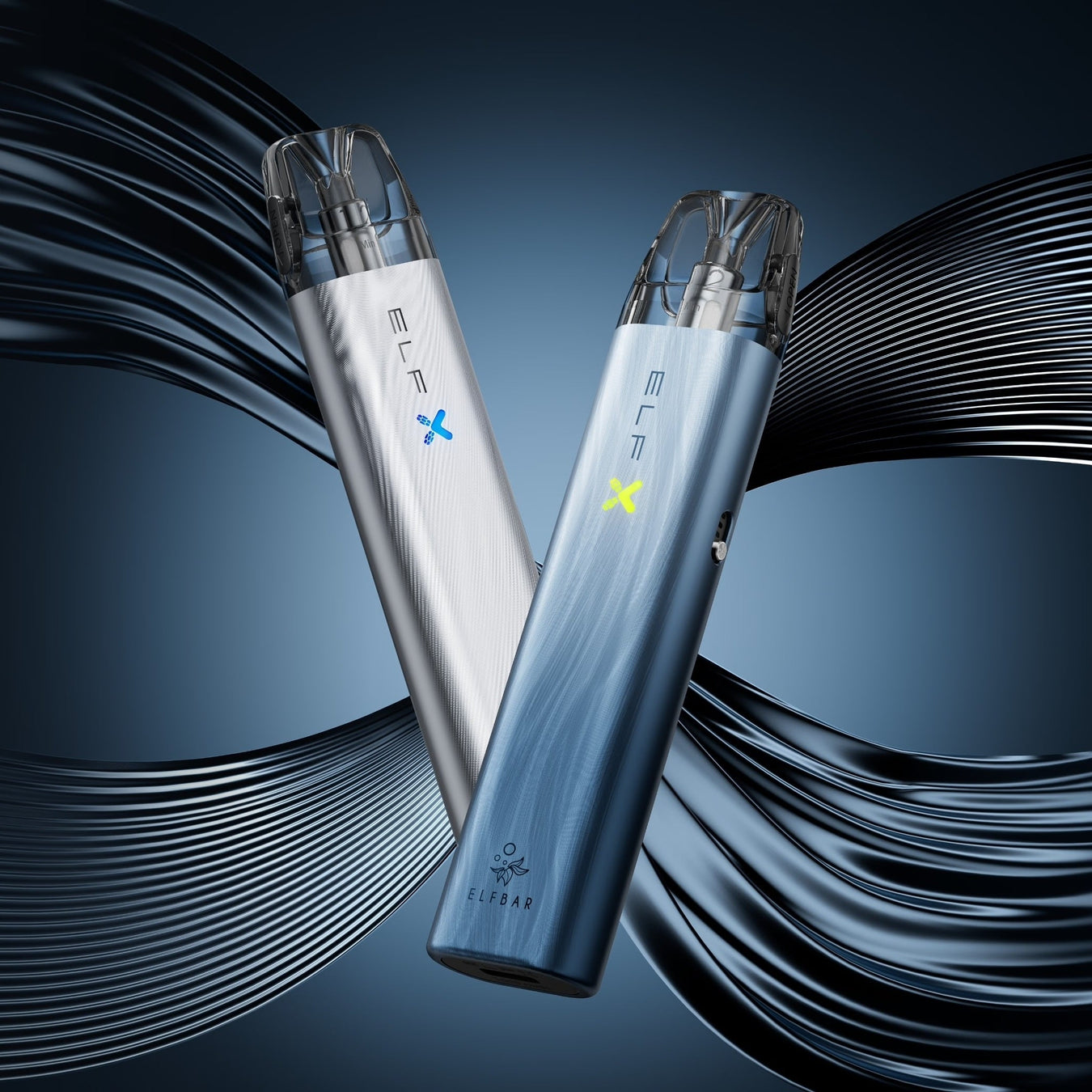
More powerful kits like the [kit name] go a step further. ELFX Kit Silver Blue, which uses dual-mesh coils and higher output power. Such devices are primarily aimed at smokers switching from cigarettes to more intense vapor and a finely tuned draw, and who can accurately estimate their e-liquid consumption.
3.6 Comparison table: Smoking vs. three vaping scenarios
The following overview summarizes the examples. These are: Experience, No exact guarantee details.
| type | Smoking/month | Disposables/month | Pods (pre-filled) | Refill pods (estimated) |
|---|---|---|---|---|
| A | 53 € | 18–24 € | 35 € | 20–25 € |
| B | 210 € | 60–90 € | 123 € | 60–80 € |
| C | 315 € | 120–150 € | 187 € | 90–120 € |
Key message:
- Disposable cigarettes are often cheaper than regular cigarettes.
- Pre-filled pods further reduce costs.
- Refillable pods are the most cost-effective option in many cases., especially for heavy users.
4. Hidden costs: fakes, taxes, disposal
Many supposed "bargains" in e-cigarettes turn out to be more expensive in the medium term – be it due to poor quality, health risks or legal problems.
4.1 Fake products and tax evasion
Customs authorities regularly warn against illegally imported disposables and liquids that do not bear tax stamps.On Zoll.de It is explained that taxed tobacco and tobacco substitute products must have the appropriate tax stamps or documentation. If these are missing, inspections may result in penalties. Tax arrears and fines.
This has three consequences for you as a consumer:
- Conduct fair price comparisons: Only products with verifiable proof of paid tax can be reliably compared.
- Legal certainty: A seemingly good deal without a tax stamp can end up being expensive.
- Quality: Illegal goods are not subject to reliable controls. Additives or nicotine content may differ from the stated information.
An important element in building trust is also official product verification. (About Serv)
4.2 Electrical and battery disposal: Who pays for what?
Disposable e-cigarettes contain batteries and electronics. In Germany, manufacturers are required to participate in a take-back system for waste electrical and electronic equipment (WEEE). This can be found in the register of the foundation. EAR trace, in which manufacturers and brands are listed with their WEEE registration.
In addition, the Battery Act requires Battery Dealers to this take back used batteries free of charge. In practice, this means you can dispose of empty disposable e-cigarettes and batteries via designated collection points or take-back systems at no extra cost. Responsible manufacturers already factor these disposal and recycling costs into the product price.
Even though this may seem like a "cost blocker" at first glance, in the long term it protects against hidden environmental levies and strengthens trust in reputable providers.
5. Practical guide: How to find your personal cost sweet spot
To ensure the figures don't remain abstract, a concrete roadmap follows on how to create your own cost comparison.
5.1 Step 1: Realistically assess your current consumption
- For one week, record how many cigarettes you smoke each day.
- Calculate the average (for example, 18/day).
- Multiply this value by the current price per box/pack.
This is how you get your monthly tobacco costs. Many people switching to alternative modes of transport experience their first "aha" moment here, because the total amount in black and white is often higher than one expects in their head.
5.2 Step 2: Select vaping scenario
Consider what type you are:
- "I want it to be as simple as possible, no refilling, no thinking" → Disposables.
- "I want some comfort, but not to constantly switch devices." pre-filled pod systems.
- "I am willing to learn small tricks to save money in the long run" → refillable pods.
If you're unsure, you can start with a compact pod system and switch to refillable pods after a few weeks. An overview of entry-level pod systems can be found in the guide to pod systems for beginners, for example in the article [article title missing]. “Choosing the right pod system for beginners”.
5.Step 3: Track consumption for 7 days
- Start with an appropriate nicotine strength (for many switchers, 20 mg/ml nicotine salt is a sensible starting point, within the TPD limit).
- For one week, count how many disposables, pods, or ml of liquid you use.
- Multiply this value by 4–4.5 to obtain a monthly value.
This creates a individual cost plan, which is significantly more accurate than any general example calculation.
5.4 Step 4: Fairly factor in hardware costs
- Specify how long you expect to use your device (6, 12 or 24 months).
- Divide the purchase price by this period.
- Add the monthly share to your utility costs.
This step is unnecessary with disposable e-cigarettes, as the hardware and consumables are combined in one product. However, with pod systems, it's worthwhile choosing high-quality battery carriers that... at least one year Maintaining a reliable service reduces unit costs per train in the long term.
5.5 Pro Tip: Fine-tune the nicotine level instead of vaping more.
Many people switching to alternative medicine find that while they have successfully quit smoking, they suddenly find themselves needing 400-500 cigarettes a day.
The simpler and often cheaper solution is a slight adjustment of the nicotine strength within the legal framework, instead of further increasing consumption. Even the switch from 10 mg/ml to 20 mg/ml can lead to a situation where one is... 1 pod/day instead of 1.5 pods/day It gets by – which noticeably reduces monthly costs.
6. Myth vs. Reality: "Vaping is much more expensive"
Several persistent myths surround e-cigarettes. One of the most common concerns the cost.
6.1 Myth: "These little things are money wasters"
This impression often arises because beginners initially buy disposable cigarettes and may also smoke regular cigarettes. During this transition phase... the costs add up – of course that looks expensive.
However, once the change is consistently implemented, the calculation from section 3 shows that:
- even with purely disposable products, a significant savings compared to cigarette consumption
- the actual savings potential at Pods and refill systems lay.
6.2 Myth: "Real savings are only possible with extremely large disposable devices"
You often read online that vaping is only possible with "5,000-
The cost comparison in this article shows that legal 2ml products perfectly sufficient for vaping that is both comfortable and cost-effective – especially when using refillable systems.
7. Health and risk aspects briefly summarized
This article deliberately focuses on costs. However, many interested parties are also asking how e-cigarettes compare to tobacco cigarettes in terms of health.
The Federal Institute for Risk Assessment concludes in its statements on e-cigarettes that the pollutant content in the vapor significantly less is like tobacco smoke, but at the same time points out that e-cigarettes not a harmless lifestyle product are and health risks remain. In the statements of the BfR It is emphasized that in particular non-smokers and certain risk groups (e.g., adolescents, pregnant women) should avoid starting.
Systematic overviews, such as those found in the Cochrane Library Studies to be published show that nicotine-containing e-cigarettes in certain study populations more effective in quitting smoking These results were compared to classic nicotine replacement therapies. They come primarily from controlled studies with adult smokers who actively seek an alternative to cigarettes and are closely monitored. Therefore, their applicability to everyday life is limited, but they offer an important clue: switching can be a sensible strategic step for many adult smokers – including cost savings.
8. Key takeaways for price-conscious commuters
- Smoking is the most expensive consumption pattern in all scenarios considered.
- Disposables They offer the most convenient entry point and are often significantly cheaper than cigarettes, especially for light to medium smokers.
- Pre-filled pods They combine comfort with clear cost savings, especially for average and heavy smokers.
- Refillable pod systems In many cases, they offer the best cost-benefit ratio – with a slightly higher initial investment and minimal learning curve.
- Legal regulations such as TPD2, the Tobacco Products Act and the Tobacco Tax Act provide clear framework conditions and at the same time explain why legally traded products They come at a price.
- Anyone comparing prices should always base their comparison on original products with correct taxation and proper registration (WEEE, BattG).
In summary, the fact check shows that "vaping is more expensive than smoking" is a myth that arises primarily during transition phases and when using extremely cheap, often illegal products. Those who are aware of their consumption, choose the appropriate nicotine strength, and opt for pod or refill systems in the medium term can significantly reduce their ongoing costs.
In addition to financial aspects, we also examine the Myth about whether vaping is a gateway drug is.
Important notice (disclaimer)
This content is for general information purposes only and does not replace No medical advice. E-cigarettes are products for adult consumers of nicotine products and are not suitable for non-smokers. Individuals with pre-existing health conditions, particularly cardiovascular or pulmonary diseases, as well as pregnant and breastfeeding women, should consult a medical professional before starting or changing their use of e-cigarettes.
Sources
- European Tobacco Products Directive TPD2: eur-lex.europa.eu/2014/40/EU
- German Tobacco Products Act (TabakerzG): laws-in-internet.de/tabakerzg
- German Tobacco Tax Act (TabakStG): buzer.de/law/8880
- Federal Institute for Risk Assessment (BfR) – Statements on e-cigarettes: bfr.bund.de/e-cigarettes
- Cochrane Library – Systematic Reviews on e-cigarettes and smoking cessation: cochranelibrary.com
- German Customs Administration – Information on tax stamps and import: zoll.de/free allowances
- EAR Foundation – WEEE Register: ear-system.de/ear directory
- Federal Ministry for the Environment, Nature Conservation, Nuclear Safety and Consumer Protection – Battery Act (BattG): bmuv.de/law/battery law
Elfbar Global Verify – product verification: elfbar.com/verify