Nicotine salt strength: how to choose correctly?
Why the right nicotine salt strength is so important
The right nicotine strength determines whether switching from tobacco cigarettes to nicotine salt e-liquids is a smooth process – or ends in frustration, headaches, and relapse. This guide shows step by step how adults can select, test, and adjust their nicotine salt strength based on their actual smoking habits.
Nicotine salts are regulated in the EU by the EU Tobacco Products Directive limited to a maximum of 20 mg/ml. In Germany, the Tobacco Products Act (Tobacco Products ActThese regulations include, among other things, a 2ml limit for pre-filled pods and disposable devices. This means that all nicotine salt products legally offered in Germany fall within a clearly defined framework – the challenge lies in finding the right strength for your individual needs within that framework.
Brief overview: What exactly are nicotine salts?
Nicotine salts are a special form of nicotine that is stabilized by combining nicotine base with organic acids (e.g., benzoic acid). As a result, the vapor feels significantly smoother in the throat than classic "freebase" e-liquids, even with the same amount of nicotine.
Overview of the advantages of nicotine salt:
- More pleasant sensation even at higher strengths (e.g. 18–20 mg/ml)
- Faster and more consistent nicotine absorption, which many former smokers perceive as more "cigarette-like".
- Very well suited for compact, low-power MTL pod systems
According to the EU TPD, ready-to-use nicotine salt e-liquids may contain a maximum of 20 mg/ml to prevent excessive nicotine intake. This value is a regulatory cap, not automatic. the “right” strength for each person.
From cigarettes to nicotine salts: The most important basic rule
When switching to nicotine replacement therapy, the most practical starting point is the number of cigarettes you currently smoke per day. Based on the experience of specialist retailers, the following rule of thumb has become established:
| Previous consumption of tobacco cigarettes | Recommended starting strength nicotine salt | Typical user description |
|---|---|---|
| 1–5 cigarettes/day | 6–10 mg/ml | “Occasional smoker” |
| 6–15 cigarettes/day | 10–15 mg/ml | “Moderate smoker” |
| 16+ cigarettes/day | 18–20 mg/ml | “Heavy smoker” |
This table is a starting point, not a rigid rule. The crucial factor is whether the chosen strength is sufficient. Desire and restlessness controlled become – without simultaneously experiencing signs of excessive nicotine consumption (e.g., headaches, nausea, dizziness).
Here's how to roughly calculate your daily nicotine intake
To better estimate one's own nicotine intake, a simple calculation method using realistic assumptions from specialist retailers can be helpful.
1. Understanding the amount of nicotine in the pod/disposable device
Example: A pre-filled pod with 2 ml and 20 mg/ml contains a total of:
2 ml × 20 mg/ml = 40 mg nicotine
A disposable e-cigarette with 2 ml and 20 mg/ml contains the same total amount. However, you take these 40 mg. not completely on – some remains in the device or is lost during exhalation.
Rule of thumb 2: Trains vs. cigarettes
In practice, the approach has become established that approximately 10–15 trains The amount of liquid in an MTL pod is roughly equivalent to a tobacco cigarette.The range results from:
- Pull length and pulling force
- Device type (power, coil resistance)
- Inhalation technique (mouth-to-lung vs. direct lung inhalation)
3. Everyday calculation example
A person who previously smoked 20 cigarettes/day now uses a 20 mg/ml nicotine salt in an MTL pod system and takes approximately 250 puffs/day.
- 20 cigarettes × 12 puffs (average 10–15) ≈ 240 “cigarette equivalents” puffs
- The actual nicotine intake is often slightly lower than with tobacco cigarettes, as combustion products are absent and some of the nicotine remains in the vapor.
What's important is not so much the exact milligram count, but rather... whether the craving calms down stably and no symptoms of overdose occur.
Step-by-step: Finding the right nicotine salt strength
Step 1: Honestly assess your smoking profile
Note down the following for 3–5 typical days:
- Number of cigarettes per day
- Situations with particularly strong cravings (e.g., after getting up, after eating, during breaks)
- Whether you tend to smoke continuously or smoke occasionally throughout the day.
Based on this data, you choose the starting strength according to the table above. Those who fluctuate should use the... higher Value – insufficient strength is one of the most common reasons for relapses.
Step 2: Choose a suitable device (MTL and low power)
Nicotine salts are for lower power output and MTL (mouth-to-lung) optimized. Excessive power with nicotine salt quickly leads to:
- A hard, scratchy pulling sensation
- headache or nausea
- Very fast nicotine absorption
Compact pod systems with 9–18 watts and resistances around 0.8–1.2 ohms typically deliver a stable, moderate vapor volume. An example of such a basic MTL device with 9–12 watts for standard pods and 15–18 watts for special turbo pods is the... ELFA MASTER Dusty Pink. In combination with pre-filled pods containing 20 mg/ml, this results in a controllable, cigarette-like draw.
Step 3: Log the first 3–5 days
Keep a brief log during the first few days:
- How many pods or disposable devices do you use per day?
- Do you estimate your moves (or do you use a device with a puff counter)?
- How often do you experience strong cravings?
- Do you have any signs of an overdose (headache, dizziness, nausea, palpitations)?
These observations are more valuable than any theoretical calculation. They show whether the chosen nicotine salt strength truly suits your everyday life.
Step 4: Gradually adjust the strength
If you still have strong cravings despite vaping:
- Strength around approx. 5 mg/ml increase (e.g. from 10 to 15 mg/ml or from 15 to 20 mg/ml)
- Check train behavior: Shorter, more powerful trains are often less efficient than longer, smoother trains.
If you notice signs of too much nicotine:
- First, the Reduce train frequency (shorter sessions, taking breaks)
- If symptoms persist, switch to the next lower strength (e.g. from 20 to 15 mg/ml)
Experience shows that adjustments should always be at least 2–3 days These settings should be retained before you make further adjustments. This way you get reliable impressions instead of snapshots.
Typical mistakes when choosing nicotine salt strength – and how to avoid them
Mistake 1: Too high a power level in an overly powerful device
A common mistake is combining 20 mg/ml nicotine salt with a high-performance device designed for large vapor clouds. This can result in significantly larger amounts of nicotine being absorbed per puff than originally intended.
Consequences:
- Very intense throat hit (scratching in the throat)
- Dizziness or nausea after just a few puffs
- Reflexively shallower, but more frequent movements that worsen the situation.
The safe combination is therefore: High nicotine salt strength + low wattage + MTL vaping technique. The ELFA MASTER device mentioned above operates precisely in this power range (9–18 watts) and is designed for MTL vaping.
Mistake 2: Choosing too low a strength due to fear of "too much nicotine"
Many people switching from cigarettes deliberately choose a very low strength, around 3–6 mg/ml, out of concern about “too much nicotine”. The problem: The craving for tobacco persists because the nicotine level is not stable enough.
Practical implications:
- Constantly sucking on the device without being truly satisfied
- Reverting to "just one" cigarette – which quickly becomes a habit again.
The DEBRA study on tobacco and nicotine use in Germany shows that electronic cigarettes are predominantly used by adult smokers seeking an alternative to tobacco cigarettes. This makes it clear that an adequate nicotine supply is crucial during the switch to e-cigarettes to prevent relapse. Data and methodology are available on the project website. DEBRA Study described in detail.
Mistake 3: Switching to nicotine-free liquids too quickly
Switching to 0 mg/ml too early risks a significant increase in nicotine cravings. Experience shows that a gradual reduction is more effective. 5 mg increments yields significantly more stable results:
- Phase 1: Stabilization with e.g. 20 mg/ml (no more tobacco, everyday cravings controllable)
- Phase 2: Switch to 15 mg/ml, observation over 2–4 weeks
- Phase 3: Switch to 10 mg/ml, etc.
In every phase, the rule is: only reduce the reduction after at least two weeks. without a major fight You can manage with the current strength.
Role of flavor, cooling, and nicotine salt strength
The perceived strength depends not only on the nicotine content but also on the flavor. Cooling flavors (menthol, ice, "snoow" blends) intensify the sensation of "freshness" in the throat and make the nicotine have a more pronounced effect.
Real-world example:
- A 20mg/ml nicotine salt with a strong cooling component feels more intense to many users than a 20mg/ml liquid with a sweet, creamy profile.
So, if you prefer very fresh varieties, you should first check the flavor when changing your taste. the same nicotine strength Maintain the dosage and only consider reducing it if symptoms persist (e.g., itching, dizziness) in the next few days.
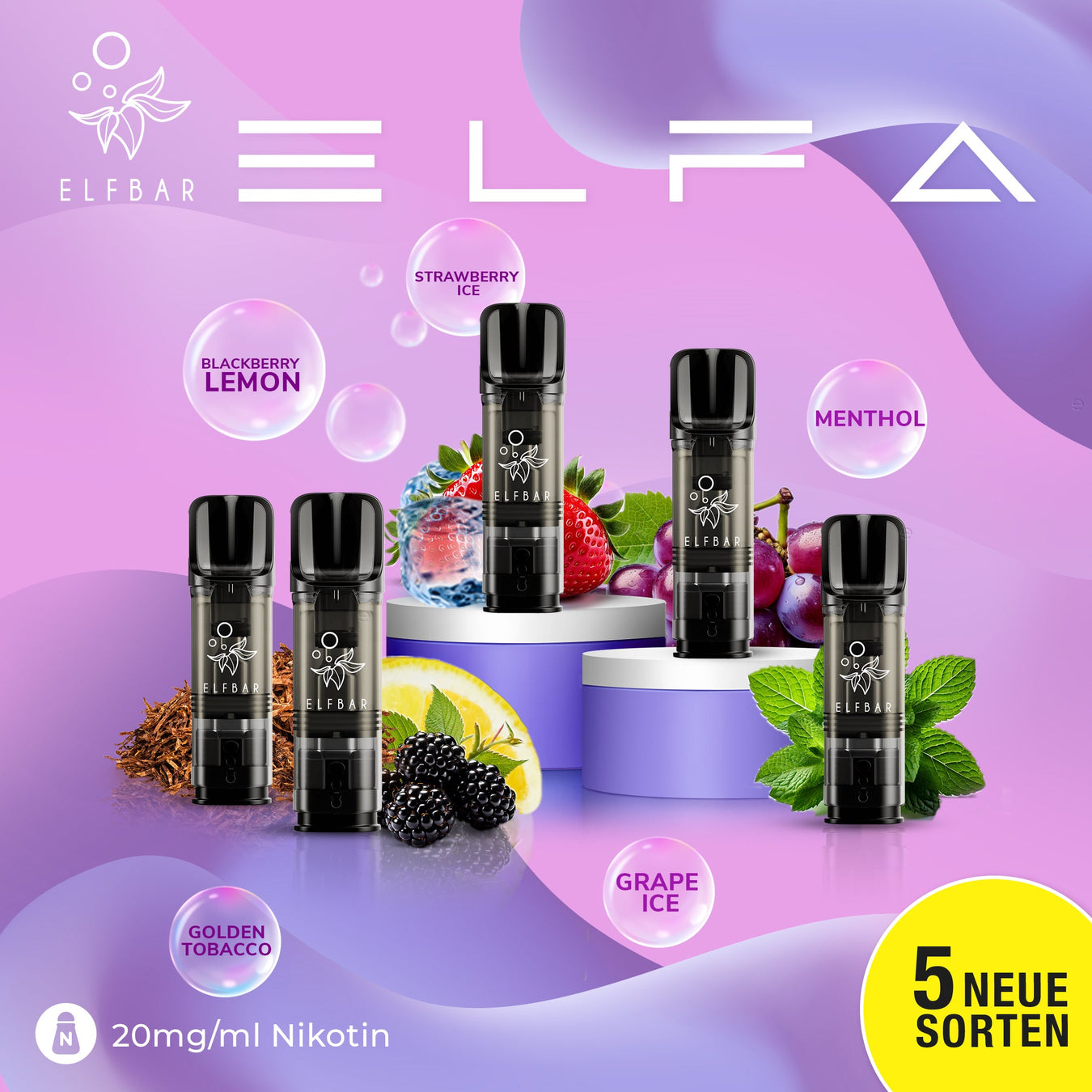
A pre-filled pod with an intensive cooling profile, such as the ELFA Prefilled Pod Berry Snoow For example, it combines a berry flavor with a cooling effect and 20 mg/ml nicotine salt. In a limited-power MTL pod system, it delivers a controllable draw despite the high nicotine strength, as long as puff frequency and pod consumption are monitored.
How regulation and taxes indirectly influence your choice
Legal limits: Why you see few options above 20 mg/ml
The EU TPD limits nicotine in refillable containers and single-use products to 20 mg/ml. Germany adopts this limit in the Tobacco Products Act (Tobacco Products Act), which additionally:
- the maximum filling volume of tanks and disposable devices is limited to 2 ml
- certain additives are prohibited
- clear guidelines for warning labels and packaging
For you, this means: If a product is legally sold in Germany, it operates within these limits. Extremely high nicotine concentrations, which exist in other markets, are not permitted here.
Taxes: Why high nicotine salt strengths are more common in 2ml formats
The German Tobacco Tax Act (Tobacco Tax ActThe EU is introducing a volume-based tax for e-liquids, which increases in several stages (e.g., €0.16/ml during the introductory phase, later €0.32/ml). Since this is tax-related per ml And since it is not taxed per mg of nicotine, it is worthwhile for manufacturers to work in smaller, highly concentrated formats.
For consumers, this means: Higher nicotine strengths in 2ml pods or disposable devices make sense from a tax and regulatory perspective – but you should still primarily look for appropriate strength and suitable device Don't decide based solely on price.
The trade associations document in VdeH Industry Report Furthermore, a growing portion of the market is threatened by untaxed, illegal products. Anyone using products without proper taxation and outside EU limits risks legal consequences and receives no reliable information on nicotine strength and ingredients.
Myth vs. Reality: Three common misconceptions about nicotine salts
Myth 1: "Nicotine salt is automatically stronger and more dangerous."
Nicotine salt feels smoother, so higher concentrations are more pleasant to vape. However, this doesn't mean that nicotine salt is "more dangerous" than freebase – the crucial factor is the actual amount ingested.
Both forms are regulated by a 20 mg/ml limit. The crucial factors are how many puffs you take per day and the power output of your device.
Myth 2: "The higher the nicotine strength, the easier the switch will be."
Excessively high e-liquid strengths often lead to users experiencing unpleasant symptoms after just a few puffs and giving up vaping altogether. In practice, a successful switch is more likely when the chosen strength reliably curbs cravings. without to trigger unpleasant side effects.
The Cochrane Library It regularly evaluates studies on the effectiveness of e-cigarettes compared to other nicotine products. Systematic reviews show that nicotine-containing e-cigarettes can help adult smokers quit and are often more effective in studies than traditional nicotine replacement products. At the same time, it is emphasized that the optimal dosage is individual and should be chosen carefully.
Myth 3: "Using nicotine salts, you automatically inhale more pollutants."
The form of nicotine (salt vs. freebase) does not change the fact that no tobacco is burned in e-cigarettes. Federal Institute for Risk Assessment (BfR) In its statements, it points out that exposure to harmful substances is significantly reduced when vaping compared to cigarette smoking, although it is not risk-free.
It's important to understand that e-cigarettes are not a wellness product, but an alternative for adult smokers. Those who don't currently smoke should not start using nicotine products.
Practical decision tree: Which nicotine salt strength suits you?
Use the following decision tree as a guide. Answer the questions in order:
-
On average, how many cigarettes per day have you smoked in the last few months?
- Up to 5 → Start with 6–10 mg/ml
- 6–15 → Start with 10–15 mg/ml
- 16+ → Start with 18–20 mg/ml
-
In which situations was the craving strongest?
- Especially during short breaks, while on the go → a higher nicotine strength is preferable so that fewer, targeted puffs are sufficient.
- Spread throughout the day, more "habit" → medium intensity and device always within easy reach
-
How sensitive is your throat to smoke or vapor?
- Very sensitive (severe cough, easily irritated throat) → start with medium strength and increase if necessary in a second step.
- Relatively insensitive → normal starting recommendation from step 1
-
After a 3-5 day test phase:
- Desire easily controlled, hardly any side effects → Maintain intensity
- Strong residual craving for tobacco, frequent "chain vaping" → check strength or vaping technique and increase moderately.
- Headache, dizziness, nausea → initially pull less frequently, if persists reduce by one level

Practical application: Three example profiles from real-world practice
Case 1: Occasional smoker with 4 cigarettes/day
- Starting point: 6–10 mg/ml nicotine salt in an MTL pod system with 9–12 watts
- Usage: Some trains in the morning, at midday, and in the evening
- Goal: To replace habitual puffs without producing strong nicotine spikes.
If, after a few weeks, there is no longer a craving for tobacco, the dosage can be reduced to 3–6 mg/ml or a gradual switch to nicotine-free liquids can be made.
Case 2: Commuters smoking 10–12 cigarettes/day
- Starting point: 10–15 mg/ml nicotine salt, e.g. in a compact pod device with pre-filled pods.
- Usage: 2-3 vaping sessions on the way to work, during lunch break and in the evening
- Goal: Clear, defined vaping breaks instead of constant sucking on the device.
If the urge increases between breaks, it's worth taking a look at the pulling behavior before increasing the strength.
Case 3: Former heavy smoker with 25+ cigarettes/day
- Starting point: 18–20 mg/ml nicotine salt, MTL, low wattage
- Usage: Several short sessions spread throughout the day, especially in known “trigger situations”
- Goal: To completely replace tobacco without constantly thinking about the next cigarette.
After 4–8 weeks of stable tobacco abstinence, initial tests with a 15 mg/ml dose may be useful. It is important not to force the reduction, but to link it to periods without significant stress.
Keep sustainability and disposal in mind
Anyone using nicotine salt in pre-filled pods or disposable devices inevitably produces electronic waste.In Germany, there are clear regulations regarding disposal:
- Electronic components fall under the Electrical and Electronic Equipment Act (WEEE).
- Integrated batteries are also subject to the Battery Act (Battery), which obligates retailers to take back used batteries
In practical terms, this means: Empty disposable devices and pods do not belong in household waste, but should be disposed of via collection points at retailers or municipal recycling centers. The registration requirement in EAR Foundation Directory ensures that manufacturers take responsibility for the take-back and recycling of their products.
Important safety signals: When you should react
When starting out with nicotine salt e-liquids, pay particular attention to the following warning signs of excessive nicotine intake:
- Sudden dizziness immediately after a few puffs
- Headache, nausea, cold sweats
- Rapid heartbeat or noticeable nervousness
If such symptoms occur, you should:
- Take a break immediately and drink plenty of water.
- Critically examine the strength and your pulling behavior.
- If symptoms persist, switch to a lower strength or, if in doubt, seek medical advice.
Conversely, a persistently strong craving for tobacco, despite frequent vaping, is an indication of too low Nicotine salt strength or a device that does not suit one's own usage patterns.
If your vaping experience isn't satisfactory, you can find out how to adjust it here. Adjust vape strength can.
What you should remember
- Choosing the right nicotine salt strength depends primarily on the number of cigarettes you previously smoked per day and your subjective cravings.
- In the EU and Germany, nicotine salt liquids are limited to 20 mg/ml and 2 ml fill volumes, creating a clear legal framework for your product selection.
- Low-power MTL devices are the right partner for nicotine salts – powerful devices and high strengths do not go together.
- Logs of puffs, pod consumption, and cravings during the first 3-5 days provide the best indication of whether an adjustment is needed.
- Reductions in nicotine salt strength should be made gradually in approximately 5 mg increments and linked to stable, low-stress periods.
Those who would like to learn more about device selection and coils in addition to nicotine strength will find further information in our article on the topic. Advantages of mesh coils for intense e-liquid flavor. For a general overview of how nicotine strength in pod systems affects the everyday experience, it's also worth taking a look at the article. Finding the right nicotine strength for your pod system.
Important notice (disclaimer)
This article is intended solely for adult users who already consume tobacco products and are looking for a less harmful alternative. It does not replace individual medical advice. People with pre-existing medical conditions, especially cardiovascular or pulmonary diseases, should seek medical advice before using nicotine-containing products. The use of nicotine products is not intended for non-smokers or minors.
Sources
- EU Tobacco Products Directive: Directive 2014/40/EU
- German Tobacco Products Act: Tobacco Products Act in the Federal Law Gazette
- German Tobacco Tax Act: Tobacco Tax Act – Law on the Levying of Tobacco Tax
- DEBRA study: DEBRA Study – German Survey on Smoking Behavior
- Industry report on e-cigarette trade: VdeH market data
- Systematic Reviews: Cochrane Library – E-Cigarettes for Smoking Cessation
- Risk assessment of e-cigarettes: Federal Institute for Risk Assessment (BfR) – E-cigarettes
- Battery Act (BattG): BMUV – Battery Act
- Register of Waste Electrical and Electronic Equipment: EAR Foundation