The role of the battery for vapor and Flavour experience
The battery of an e-cigarette determines whether a puff is full, flavorful, and consistent – or weak, watery, and inconsistent. This article explains how battery capacity, discharge current, voltage drops, and device maintenance directly affect vapor production and e-liquid flavor intensity. The focus is on rechargeable pod systems and how simple routines can help you achieve more flavor, greater consistency, and a longer device lifespan.
Why the battery for vaping and Flavour so important
With each inhalation, the coil (heating element) draws power from the battery. This electrical power (watts) determines how quickly and intensely the e-liquid is heated. Too little power results in thin, flat vapor.
A stable battery ensures that this power remains as constant as possible during a puff. In practice, this is evident: as soon as the voltage under load drops by about 10–15% (so-called "voltage sag"), users report a noticeable difference.

Legal framework: Why your devices are built the way they are
For modern pod systems to be sold in Germany, they must meet strict requirements. The EU Tobacco Products Directive, for example, limits the maximum nicotine concentration in refillable e-liquids to 20 mg/ml and mandates warning labels. Germany has implemented these requirements in the Tobacco Products Act (TabakerzG).
After BMEL Tobacco Products Act The filling volume of refillable containers and pods is limited to 2 ml. This limit determines how pods and tanks are designed – the battery must therefore be compatible with relatively small tanks and utilize the available liquid supply as efficiently as possible. In parallel, the EU TPD The information obligations and safety requirements are defined. For you as a user, this means: Batteries in modern systems are deliberately designed for moderate, controlled performance ranges to ensure a good balance of
To protect your devices, make sure you use the correct Storage and safety of vape batteries.
Technical basics: How battery parameters shape the vaping experience
To understand why an 850 mAh battery "tastes" different than a 500 mAh battery, it's worth taking a look at the key specifications.
Capacity (mAh): Runtime and reserves
The capacity is given in milliampere-hours (mAh) and describes how much charge the battery can store. In everyday terms, this simply means: How many
Typical values in modern pod systems:
| Battery capacity | Typical device | Practical impression |
|---|---|---|
| approx. 500 mAh | compact sticks | Good battery life with moderate use, but noticeable voltage drop at the end of the day. |
| 650–850 mAh | medium pod systems | noticeably more stable performance throughout the day, fewer "aroma drops" in series |
| 1,000–1.200 mAh | performance-oriented pod kits | Designed for 0.6–0.8 Ω mesh coils with 15–30 W, very consistent draw feel even with intensive use |
Practical observation: For 0.6–0.8 Ω mesh coils operating in the range of approximately 10–30 W, batteries with a capacity of around 650 mAh or higher deliver significantly more stable results in compact systems, especially with multiple coils.
Voltage and Voltage Say: Why the same battery level doesn't always taste the same
Batteries do not deliver a "fixed" voltage. Under load, the applied voltage drops depending on the battery's internal resistance. This effect is called voltage sag.
- High internal resistance or partially discharged battery → stronger drops in performance, vapor feels "watery".
- Low internal resistance and well-maintained battery → voltage remains stable under load, aroma and vapor remain constant.
In practice, it turns out that if the voltage drops by about 10–15% during a puff, the same coil suddenly becomes significantly weaker – even though technically there would still be "enough" remaining capacity. Many users mistake this effect for a "defective" pod and replace it too soon.
Discharge power and coil resistance: Finding the perfect duo
Power (watts) is determined by voltage and resistance (ohms). For pod systems, the combination of mesh coils with 0.6–0.8 Ω and moderate power outputs has proven effective because it produces dense vapor and intense flavor.
For intensive
A rule of thumb from practical experience:
- 0.8 Ω mesh coil → ideally around 12–18 W
- 0.6 Ω mesh coil → ideally around 18–25 W
This requires a battery that can deliver this power stably even under load. A 500 mAh battery can reliably power typical 0.8 Ω mesh coils, while a 1000 mAh battery with optimized electronics can also power 0.6 Ω coils up to about 30 W with a clearly noticeable reserve.
Practical examples: How different batteries affect the Flavour change
To make the role of the battery more tangible, it is worthwhile to compare typical configurations from practical experience.
Scenario 1: Compact pod system with 500 mAh battery
A compact pod system with a 500 mAh battery and a 1.1 Ω pod operates in the power range of approximately 9–12 W. For everyday users with a moderate puff frequency, this is often sufficient for a workday. However, as soon as longer puff sessions are added, the voltage level drops more quickly, especially below 30% remaining charge.
Typical user feedback: "Everything tastes great in the morning, but from the afternoon onwards the liquid tastes significantly weaker, even though the pod is still half full." The reason is usually not a bad coil, but the battery: Under load, the voltage drops, the effective power decreases by 15–20%, and the flavor tastes diluted.
Scenario 2: Performance-oriented pod kit with a 1,000 mAh battery
A modern pod kit with a 1000 mAh battery and 0.6–0.8 Ω mesh pods, as well as adjustable power (up to approximately 30 W), is aimed at users who appreciate dense vapor and consistent intensity. The combined capacity and electronics optimized for mesh coils ensure that the voltage remains significantly more stable under load.
Internal practical tests show that, with identical coil specifications, a 1000 mAh battery often maintains the desired performance level in everyday use 30–40% longer than a 500 mAh battery before users notice a significant difference.
ELFA , ELFA Master and ELFX In context: What their batteries can do
Rechargeable Pod systems They deliberately opt for integrated batteries that are perfectly suited to the pod design. Three examples illustrate how significantly battery sizes and power ranges affect vapor production and performance.
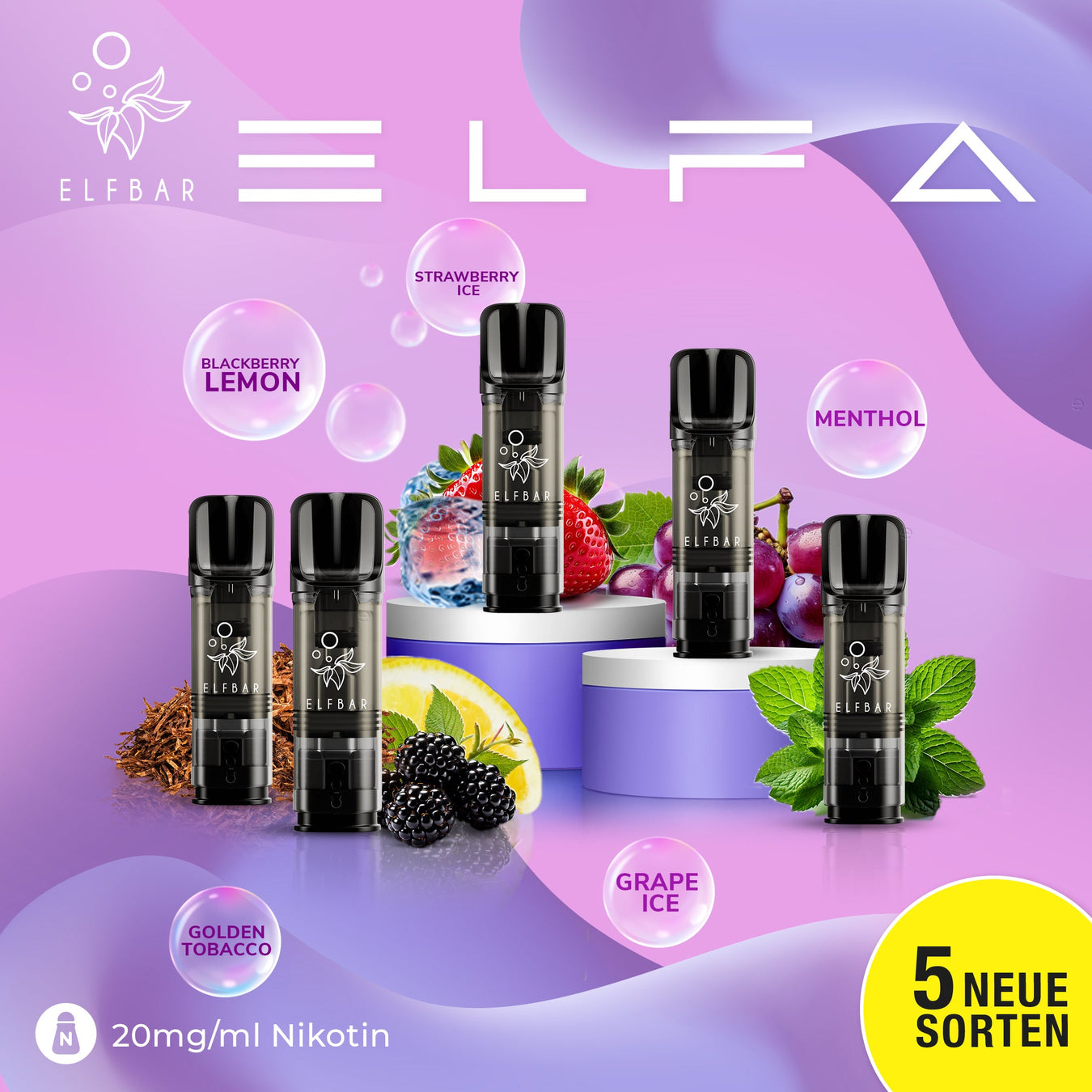
ELFA Base unit: Mobility and everyday usability (500 mAh)
The
For users who primarily value uncomplicated operation, a handy format and good performance.
ELFA Master More reserves for mesh coils (850 mAh)
The
Performance areas of the
- 9–12 W for 1.1-Ω-
ELFA -Refillable pods and pre-filledELFA -Pods - 15–18 W for 0.8-Ω-
ELFA -TURBO-Refillable-Pods
Thanks to the larger battery, the power output remains stable for longer, even with 0.8-ohm mesh pods. In practice, this shows that those who use many series will benefit.
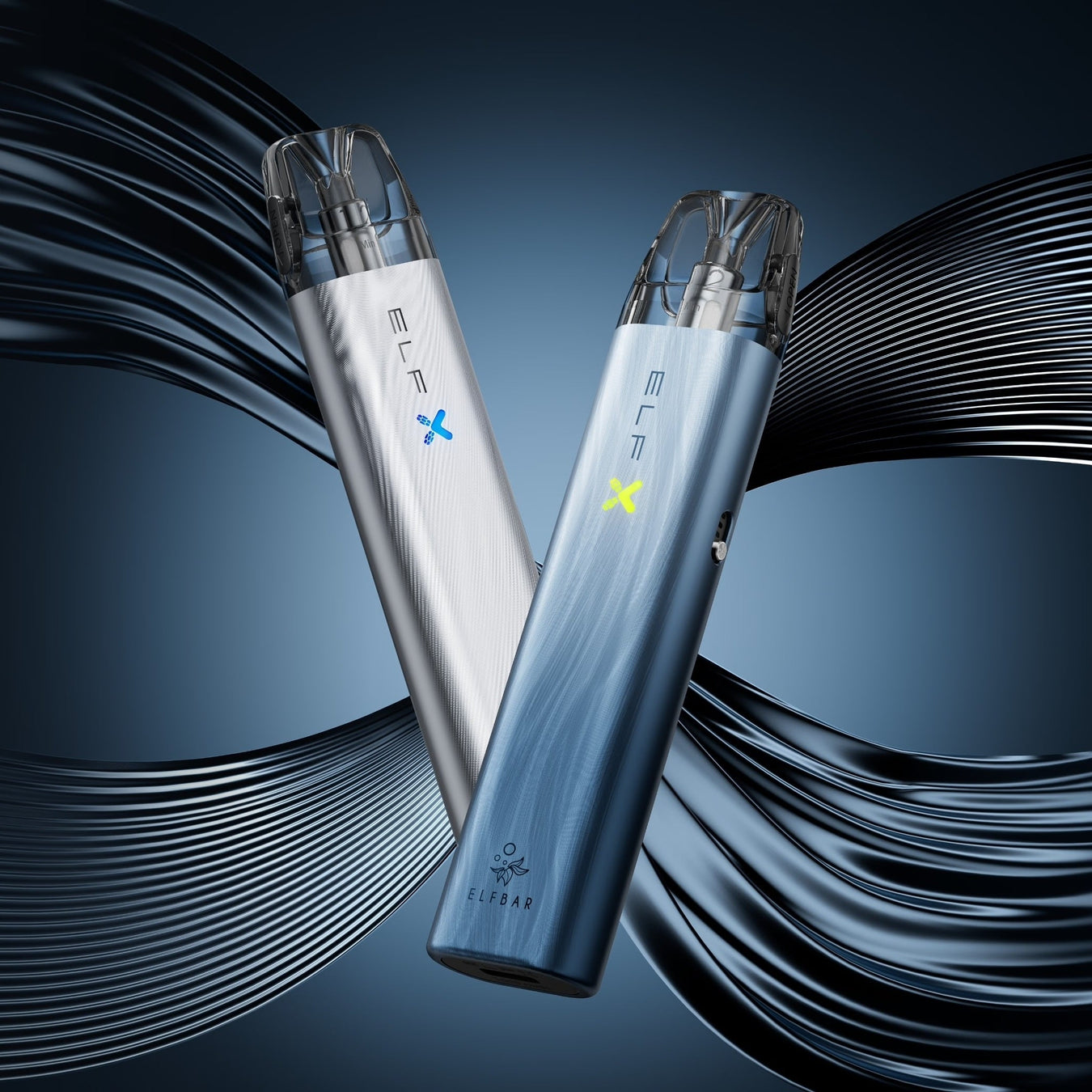
ELFX Kit: 1000 mAh for flexible power output up to 30 W
The
In combination with 0.6-Ω mesh coils, operated in a power range of approximately 18–25 W, the 1000 mAh battery delivers noticeably consistent performance over many sessions.
USB-C fast charging: Why charging behavior matters Flavour influenced
Besides the pure battery capacity, the charging behavior determines long-term stability. Modern pod systems rely on USB-C with defined charging currents, such as 5V/1A. If charged continuously with significantly higher currents (z.B. (e.g., with fast-charging power adapters for laptops), the cell temperature rises. Over time, this increases the battery's internal resistance – the result: voltage sag occurs sooner.
A practical rule of thumb:
- Ideally, use a power adapter that matches the charging current recommended by the manufacturer (1 A for many pod systems).
- Charge at normal ambient temperatures. Temperatures above approximately 45°C (z.B. You should avoid areas near heating systems (cars in summer).
The German Battery Act (BattG) It primarily addresses take-back and disposal obligations, but makes it clear that batteries, as chemical products, are sensitive components. Careful charging not only extends the battery's lifespan but also reduces the frequency of disposal – a benefit for both the environment and your wallet.
Maintenance and care: How to care for the battery and contacts for maximum performance Flavour Keeping fit
Many users replace pods and coils too early because they
Step-by-step checklist at Flavour loss
Before disposing of the pod, go through this sequence:
- Check charge level: If the battery level is visibly below one-third, first fully recharge it using a suitable USB-C cable. Then test again.
- Check cable and port: A worn or dirty cable can cause charging problems. Replace the cable if necessary.
- Reinsert or replace the pod: Remove the pod, check the contacts with a dry contact, and reinsert the pod. If available, test with a second pod.
- Test a second device: If possible, test the same pod in another, fully charged device. Is the same issue there?
Flavour The problem lies with the battery of the first device. It's significantly better. - Observe safety shutdowns: Many modern devices limit their power output if the voltage is too low or they overheat. If the device flashes or refuses to activate, it's more likely a protection mechanism malfunction than a coil problem.
Experience has shown that this systematic troubleshooting significantly reduces the number of unnecessarily discarded pods and helps to better assess the actual condition of the battery.
Regular cleaning: Small measure, big effect
Contact problems between the pod and battery are an underestimated issue.
Recommended routine:
- Once a month, clean the contact pins of the battery carrier and the corresponding parts on the pod with a cotton swab lightly moistened with isopropanol.
- Allow to dry briefly after cleaning before reinserting the pod.
Many users report that after such a cleaning, even older devices seem significantly more "alive" again. The perceived
Storage and cycles: How to keep the battery stable for a long time
Lithium-ion batteries benefit from not being constantly discharged to 0% or kept permanently at 100%. Deep discharges and continuous full charging increase cell wear and tear, thus increasing internal resistance.
Practical recommendations for pod systems:
- For everyday use: More frequent, shorter charges are in many cases easier on the battery than constantly "shutting down until it flashes".
- For longer breaks (z.B. (several weeks): Store the device at approximately 40–60% charge and keep it in a cool, dry place.
Studies and manufacturer experience show that this can extend the usable number of cycles of a battery by up to 20–30%. This means the battery stays longer in the range where it provides your coil with stable power – and thus remains in the "sweet spot" for longer.
Interaction with mesh coils: Why stable batteries deliver more intense flavor
Mesh coils have a significantly larger surface area compared to classic round wire coils. This allows them to vaporize more e-liquid at the same wattage, producing dense, rich vapor. However, they are also very sensitive to fluctuations in wattage.
In a detailed article on the Advantages of mesh coils for intense e-liquid
The battery also plays a role in troubleshooting. The guide "Burned
Common misconceptions about the role of the battery – and what is actually true
Myth 1: “If the Flavour "If it deteriorates, it's always the coil's fault."
Many users reflexively change the pod as soon as the flavor diminishes. In practice, however, it regularly turns out that the battery already drops significantly under load or the contacts are dirty. A quick test with a fully charged battery and cleaned contacts often shows that the "old" pod is still perfectly fine.
Myth 2: "Always charging to 100% is best."
Continuously charging to 100% and then leaving the battery plugged in for days puts a strain on the cells. For practical everyday use, it's more sensible to operate within a range of approximately 20 to 80%, if usage allows. This keeps the internal resistance lower in the long term and maintains stable performance.
Myth 3: "Fast charging power adapters never hurt – the main thing is that it charges."
High-performance power supplies are convenient, but not all electronics are designed for high charging currents. If a pod system is continuously charged with significantly higher currents than intended, temperature and cell stress increase. This negatively impacts lifespan and leads to premature voltage sag.
Safety, disposal and responsibility
Batteries are durable but sensitive components. Responsible handling ensures stable performance.
Disposal and take-back
After Battery Act (BattG) Retailers are obligated to take back used batteries and rechargeable batteries free of charge. Users should therefore not dispose of empty or defective devices in household waste, but rather return them to collection points or retailers. The foundation EAR It documents the registration obligation of manufacturers and importers of electrical appliances and batteries – an indication that reputable suppliers register their products in the interest of sustainable disposal.
Health classification of e-cigarettes
The quality of the battery does not change the fact that e-cigarettes are a product for adult consumers and should not be considered "healthy." However, the German Federal Institute for Risk Assessment (BfR) classifies the potential risks of e-cigarettes as significantly lower compared to traditional cigarettes in its statements on the subject, provided that products are manufactured and used according to applicable regulations. In the publications of the BfR on e-cigarettes However, it is emphasized that long-term risks have not yet been fully assessed and that a conscious, informed approach remains necessary.
Compact decision-making aid: Which battery type suits your vaping habits?
The following overview helps to classify the appropriate device in terms of battery capacity and performance range:
| User type | Traction behavior | Recommended battery capacity | Typical coil areas | Expected benefits |
|---|---|---|---|---|
| Occasional steamer | few short | approx. 500 mAh | 1.1 Ω at 9–12 W | lightweight device, sufficient battery life, good |
| everyday users | regular | 650–850 mAh | 0.8–1.1 Ω at 12–18 W | stable |
| Heavy user/flavor chaser | frequent series | 1,000–1,200 mAh | 0.6–0.8 Ω at 18–30 W | very consistent performance, intense |
Important: This classification is a practical guide. The decisive factor is always the interplay of battery size, electronics (adjustable power, protection mechanisms) and coil design.
Important insights for your everyday life
- The battery is not just a power source, but the heart of your vaping and
Flavour experience. - Voltage sag due to high internal resistance or low charge level is one of the most common causes of declining performance.
Flavour – often even before a coil is actually worn out. - Suitable battery capacity and discharge power are crucial to ensure that 0.6–0.8 Ω mesh coils can operate consistently in the 10–30 W range.
- Devices with 650–1,000 mAh batteries deliver noticeably more stable results in practice than very small batteries, especially with frequent series of shots.
puffs n. - Simple maintenance – regular cleaning of the contacts, moderate charging behavior, avoiding extreme temperatures – can significantly extend the battery life.
- Legal requirements such as Tobacco Products Act and EU TPD ensure that modern devices operate within clearly defined performance and safety parameters.
FAQ: Frequently asked questions about the role of the battery
Does the battery level really affect the
Yes. As soon as the voltage drops significantly under load – typically when the remaining charge falls well below 30% – the effective power at the coil decreases. The vapor becomes thinner, and the flavor is less pronounced.
Why does my pod taste better in the new device than in the old one?
The battery in the new device is likely more powerful or has a lower internal resistance. This allows the coil to deliver the intended power more consistently.
How often should I clean the contacts?
A monthly cleaning is a good guideline. More frequent cleaning may be advisable with heavy e-liquid consumption or frequent pod changes.
Is USB-C fast charging bad for the battery?
As long as the charging current remains within the recommended range (z.B. USB-C (5V/1A) is very battery-friendly. Problems arise when power supplies deliver significantly higher currents than the device is designed to support.
When should I replace my device?
If the
Note: This article is for informational purposes only and does not replace medical advice. Individuals with pre-existing medical conditions or specific health concerns should seek medical advice before using e-cigarettes.
Sources
- Tobacco Products Act – Law on Tobacco Products and Related Products
- EU Tobacco Products Directive 2014/40/EU
- Battery Act (BattG) – Federal Ministry for the Environment
- Federal Institute for Risk Assessment – Publications on e-cigarettes
- User reviews and technical analyses from German-speaking vaping communities (z.B. E-smoking forum, vaping meeting) as well as internal practical tests on voltage drops and battery aging.