Sub-Ohm vaping with a pod system: A guide for professionals
Sub-ohm vaping with pod systems is the point where "normal" vaping meets true fine-tuning. Modern pod kits with adjustable wattage, airflow control, and mesh coils now deliver performance that was previously reserved for large box mods – but only if they are precisely calibrated.
This guide is about sub-ohm vaping. especially with pod systems. The focus is on practical settings for experienced users, legal frameworks in Germany, and specific setups with high-performance pod devices such as ELFX, ELFX Pro,
Find out if the
1. What does sub-ohm vaping mean in the context of pod systems?
When sub-ohm vaping (sub-ohm = resistance) below 1.0 ΩMore current flows through the coil, the atomizer heats up faster and vaporizes more e-liquid per puff. This results in dense clouds and intense flavors – but only if the coil, wattage, airflow, and e-liquid are compatible.
1.1 Classic Box Mod vs. Modern Pod Systems
Sub-ohm vaping used to mean: large battery carrier, 100+ watts, huge tank. Today, compact devices deliver... Pod systems with 0.6–0.8 Ω Mesh Coils and 20–45 watts a similar
A typical example is pod kits with dual mesh pods in the 0.6–0.8 Ω range and up to 30–45 watts. Here, efficient mesh technology meets a moderate sub-ohm power level – ideal for advanced users who want more than "just MTL" (mouth-to-lung) but aren't looking for a massive cloud-chasing setup.
1.2 Legal framework: Why 2 ml and max. 20 mg/ml?
For Germany, the legal framework is clearly defined:
- The Tobacco Products Act (TabakerzG), available at BMEL, implements the EU Tobacco Products Directive (TPD). This includes, among other things: maximum 2 ml filling volume for refillable pods and tanks.
- The underlying EU Tobacco Products Directive 2014/40/EU According to Article 20, a maximum nicotine concentration of 20 mg/ml for nicotine-containing liquids, as well as extensive warnings on the packaging, which can be read in full on eur-lex.europa.eu.
This explains why extremely large Disposabledevices with several thousand
1.3 Sub-Ohm in Pods: Realistically Classifying Power Ranges
Sub-ohm vaping with pod systems usually operates in the range 0.4–0.8 Ω and 20–45 watts. The goal is not maximum steam, but rather:
- more intense
Flavour - controllable heat generation
- everyday liquid consumption
A 0.6-Ω mesh pod at 25–30 watts can
2. Technical basics: Coils, Mesh & Understanding performance
2.1 Why mesh coils have a clear advantage for sub-ohm pods
Mesh coils use a finely perforated metal mesh instead of classic wire winding. The advantages of sub-ohm pod systems are clear:
-
Larger surface area: more contact area with the liquid, therefore more intensive
Flavour . - Faster heating: The mesh reaches its operating temperature in fractions of a second.
- More even heat distribution: This results in fewer hotspots and a lower risk of dry hits.
Those who would like to read about the functionality in detail can find it in our article. "How does a mesh coil work in your pod system?" A technical in-depth explanation with graphics and example setups.
2.2 Practical rule: How to choose the right power for 0.6–0.8 Ω pods
Experienced pod users have established a simple and practical rule across many setups:
Start at about 70–80% of the coil's upper wattage recommendation and then gradually increase in 1–2 watt increments.
Example: If a 0.6Ω mesh pod has a recommended range of 20–30 watts, many professionals start at 24–26 watts. From there, they adjust to...
Pro Tip: If you are starting from a fresh coil, go never directly at the upper wattage limit. The fresh cotton material needs some time
2.3 Coil Lifespan: Realistic Expectations
Mesh pods in high-quality systems typically achieve the following runtimes:
- 1–2 weeks with intensive use (several pods per day)
- 2–4 weeks with moderate use
You should change the pod sooner if:
- the
Flavour flat or "musty" - the train suddenly becomes significantly tighter (coking)
- A slight scratchiness occurs, even though the liquid is unchanged.
A detailed troubleshooting guide specifically for mesh coils can be found in the article. "Burned
3. Liquids & Wicking: PG/VG, nicotine and sub-ohm pods
3.1 PG/VG ratio for sub-ohm pod systems
For compact pod systems with mesh coils, practical experience has shown:
- 60–70% VG (Vegetable glycerin) at 30–40% PG offers a good balance of vapor production and flow.
- ≥ 70% VG It can quickly become tough in small coil openings and clog pods.
-
50/50 liquids While they are very fluid and run well, at high power levels they tend to "wash out" the coil more quickly.
Flavour It becomes more diffuse and the lifespan decreases.
The article offers a detailed examination of the PG/VG issue – including throat sensation and temperature behavior. "PG/VG ratio: Which e-liquid for your pod system?".
3.2 Nicotine strength in the sub-ohm range: Why less is more
The EU-TPD It limits the nicotine strength to 20 mg/ml. While this is technically possible for sub-ohm setups, it is almost never practical.
Experienced pod vapers typically work with the following in the sub-ohm range:
- 3–6 mg/ml with free base (freebase nicotine)
- up to approximately 10–12 mg/ml in very restrictive, “half” sub-ohm setups (e.g.0.8 Ω in the lower watt range)
Expert Warning: A common mistake is the combination of high nicotine salt strengths (e.g. 20 mg/ml) with sub-ohm mesh coils. The significantly higher liquid consumption can quickly lead to excessive nicotine consumption and very harsh side effects.
3.3 Wicking rules for pod mesh coils
The following heuristics have proven effective for the interaction between liquid and wicking material:
- Target range for sub-ohm pods: 60–70% VG
- Above (≥ 70% VG): only with very good wicking properties and rather lower power outputs
- (50/50): more suitable for moderately used pods, otherwise faster coil wear.
It is also important that Usage behavior:
- Between
puffs Leave a 5-10 second pause to allow the cotton to retract. - With strong chains
puffs Reduce power by 1-2 watts. - At the first sign of a "dry" draw, stop immediately and check the pod.
4. Configuration Blueprint: How to Build Your Sub-Ohm Pod Setup
This section guides you step-by-step through a practical setup using modern pod systems that combine sub-ohm power, adjustable wattage, and airflow control.
4.1 Device selection: What advanced users should pay attention to
For ambitious sub-ohm pod users, the following device features are crucial:
- Adjustable power (at least 20–30 watts, better up to 40–45 watts)
- Clear display of watts, coil resistance and battery level
- Compatible mesh pods in the 0.6–0.8 Ω range
- Large battery (≥ 800–1,200 mAh) with USB-C fast charging
- Reliable airflow control (DL to restrictive RDL)
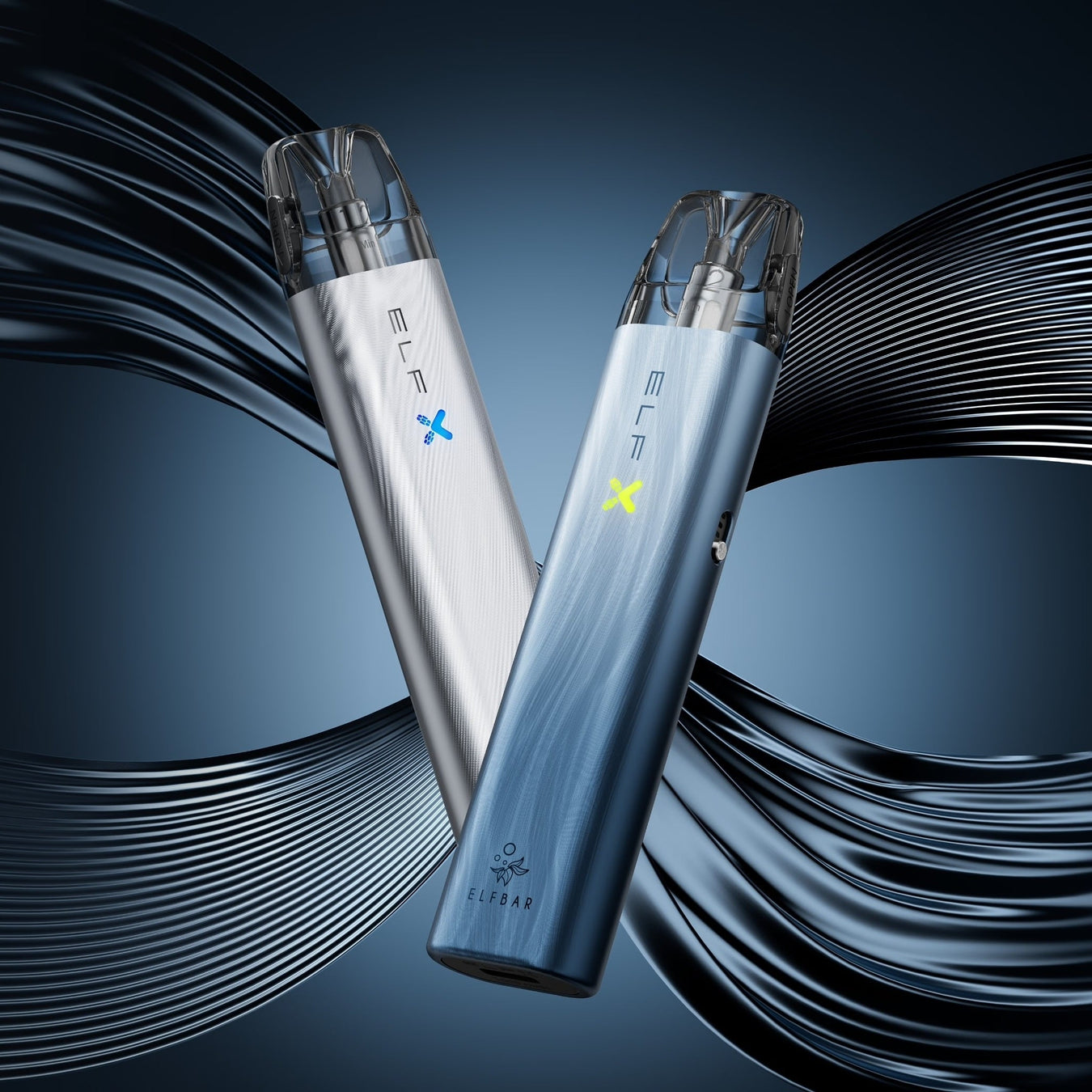
An example of a high-performance professional pod kit is the ELFX Pro Pink With up to 45 watts of output power, a 1200 mAh battery, a color display, and refillable 0.6 and 0.8 Ω ELFX pods with dual-mesh coil technology, this combination covers the entire spectrum from restricted RDL to open DL in a pod format.
Those who initially want to focus on somewhat lower performance levels will find what they're looking for in the ELFX Kit Silver Blue With up to 30 watts and a 1,000 mAh battery, it's a balanced option for
4.2 Setup example: ELFX Pro with 0.6-Ω pod
A realistic "professional setup" with a sub-ohm pod could look like this:
- Device: powerful pod system with up to 45 watts and a 1,200 mAh battery
- Coil: 0.6Ω mesh pod (dual mesh)
- Liquid: 65/35 VG/PG, 3-6 mg/ml nicotine (freebase)
- Train type: RDL to open DL
Configuration steps:
-
prime coil: Fill the pod, let it stand for 5–10 minutes, take 2–3 dry puffs before the first puff.
puffs without firing (with devices that have automatic draw activation, refrain from doing so and wait longer instead). - Adjust performance: If the pod recommends, for example, 20–30 watts, then... 24–26 watts start (70–80% of the upper limit).
-
Airflow approximately open to two-thirds – a good starting point for balanced clouds and
Flavour . - 3–5 shorter
puffs (2 seconds) while focusingFlavour and pay attention to temperature. - In 1-2 watt increments Approach the sweet spot until
Flavour , Heat and tensile resistance are in harmony.
Many advanced users end up with 0.6-Ω pods in practice. 25–32 watts, depending on the liquid, personal draw length and desired vapor density.
4.3 Setup example: ELFA Master with 0.8-Ω TURBO pod
Those who want to vape in a more restricted way, but still benefit from mesh and turbo pods, can use a setup like this:
- Device:
ELFA Master Base unit with 850 mAh battery - Pod:
ELFA TURBO Refillable Pod 0.8 Ω (Mesh coil, refillable) - Performance range: according to the manufacturer 15–18 watts in the 0.8 Ω range
- Liquid: 60/40 to 65/35 VG/PG, 6–10 mg/ml nicotine
Configuration steps:
- Fill the pod with 60–70% VG liquid and let it rest for 5–10 minutes.
- Performance on approximately 70–80% set the upper limit, so here approximately 15–16 watts.
- Airflow rather half open Start – for a clearly noticeable, but not too open RDL.
- Depending on the desired density, increase in 1-watt increments towards 18 watts, or stay at 15 watts if it gets too hot otherwise.
This type of setup is particularly suitable for switchers who come from classic MTL pods and want to work their way into the sub-ohm range in a controlled manner.
4.4 Checklist: Your personal sub-ohm pod starting point
| component | Recommendation for advanced users |
|---|---|
| Coil resistance | 0.6–0.8 Ω Mesh |
| Starting power | 70–80% of the upper wattage rating |
| Liquid | 60–70% VG/30–40% PG |
| Nicotine strength | 3–6 mg/ml (freebase), max. ~10–12 mg/ml with very restrictive RDL |
| Airflow | Open approximately 2/3, then adjust in 10–20% increments. |
| train length | 2–3 seconds per pull, pauses of 5–10 seconds between pulls |
5. Airflow, traction technology & fine-tuning
5.1 Airflow Tuning: Systematic Approach
Instead of adjusting the airflow "by chance," experienced vapers use a structured approach:
- Airflow at approximately... two-thirds open place.
- Several short
puffs (2 seconds) at constant power. -
- More
Flavour Want a denser, but warmer airflow? → Airflow gradually closing (e.g., to 50%). - Cooler, airier, bigger clouds desired? → Airflow open further in 10–20% increments.
- More
- Always with just a few
puffs Test it instead of constantly adjusting it while vaping.
This way you can reliably find the point where coil, power and airflow harmonize, without unnecessary effort.
5.2 Train technology: RDL vs.DL in the pod system
In the sub-ohm pod spectrum, two vaping techniques play the main role:
- RDL (Restrictive Direct Lung): Direct lung inhalation, but with noticeable resistance; ideal for 0.6–0.8 Ω at 18–30 watts.
- DL (Direct Lung): Very open draw directly into the lungs; more suitable for high-performance devices with 0.4–0.6 Ω and >Designed for 25 watts.
Many advanced users use RDL in everyday life because it's so consumption, battery life and
5.3 Typical problems: Spitback, leakage, dryness puffs
Spitback (small liquid droplets in the mouth):
- This often occurs with overfilled pods or after priming.
- Solution: Briefly remove the pod from the device, wipe the mouthpiece with a paper towel, and make 2-3 short, strong movements.
puffs If there is no external fire button, reduce the power by 1-2 watts.
Leaking (liquid in the airflow area):
- Causes: liquid too thin (50/50 at high power), defective pod or pod inserted too loosely.
- Solution: Ensure the pod is properly inserted, switch to 60–70% VG, and replace the pod if necessary.
Dry Hits:
- Causes: excessive power, insufficient breaks, liquid too thick.
- Solution: Reduce power output, extend breaks, check liquid viscosity.
6. Battery, Safety & legal compliance
6.1 Battery Management for High-Performance Pod Systems
For sub-ohm pods with 0.6–0.8 Ω, the following practical rule of thumb has become established:
- 800–1,200 mAh Depending on the power output, this corresponds to a full day of moderate sub-ohm use.
- Ideally, the battery should not be regularly submerged. 20% remaining capacity unloaded.
- Charging preferably with the included USB-C cable and the charging current specified in the manual (e.g. 5 V/1 A or 5 V/2 A).
A common mistake is charging with particularly powerful USB power adapters (e.g., notebook power adapters) without considering the device's maximum recommended charging current. Over time, this can reduce battery life.
6.2 Taxes, Labeling & Black market
In Germany, sub-ohm pod systems are subject to both product regulation and taxation:
- The Tobacco tax for liquids is in Tobacco Tax Act (TabakStG) It is regulated there. It stipulates that the tax on liquids for use in e-cigarettes will be gradually reduced from 0,16 € on 0,32 € per ml increases – details can be found in the legal text at buzer.de.
- This tax makes up a significant portion of the final price and explains why "extremely cheap" imported goods are rarely taxed legally.
The customs service points this out on its information pages under zoll.de pointing out that for e-cigarette liquids Control characters and correct taxation This applies. Untaxed or incorrectly declared goods not only endanger your own health (due to unclear ingredients), but can also lead to other health problems. tax consequences lead.
6.3 Disposal & Environmental responsibility
High-quality pod systems with refillable pods significantly reduce electronic waste compared to mass-produced disposable devices. Nevertheless, they will eventually fall apart. Batteries and pods as waste.
The separation is important:
- Devices with permanently installed batteries are considered waste electrical and electronic equipment and should be disposed of via municipal collection points.
- Pods without electronics belong in the general waste, not in the recycling for glass or paper.
The German Battery Act (BattG), documented at BMUV, Retailers are also obligated to take back used batteries. Those who use devices long-term and only replace the pods reduce waste and make good use of the existing infrastructure.
7. Health aspects & responsible use
7.1 Risk communication: What do official bodies say?
The federal institutes in Germany clearly point out that no The consumer product is completely risk-free. At the same time, the Federal Institute for Risk Assessment (BfR) in his statements on e-cigarettes to the conclusion that the The pollutant load of the aerosol is significantly lower than that of tobacco smoke., This can be read in the technical information on bfr.bund.de.
This assessment is aimed primarily at adult smokers seeking alternatives to traditional tobacco cigarettes. Authorities strongly recommend that non-smokers, and especially young people, not start using nicotine-containing products in the first place.
7.2 Sub-Ohm & Nicotine intake: Why professionals dose carefully
Sub-ohm setups vaporize significantly more liquid per puff as classic MTL pods with 1.0–1.2 Ω. Anyone switching from an MTL device with 12–20 mg/ml to a sub-ohm pod system and leaving the nicotine strength unchanged will quickly ingest significantly more nicotine.
Responsible users therefore rely on [the following] in the sub-ohm range. reduced nicotine strengths (often 3–6 mg/ml) and consciously observe how their consumption habits change. If signs of discomfort, nervousness, or dizziness occur, the nicotine dose should be reduced or vaping should be paused.
7.3 For whom are sub-ohm pods useful – and for whom are they not?
Sub-ohm pod systems are particularly useful for:
- adult smokers who have open, direct traction technique prefer and would like to replace cigarettes
- experienced vapers who are more
Flavour and steam want to do it without switching to large box mods - Users who are willing to engage with Performance, airflow and liquid to deal with it technically
Sub-ohm setups should be used with caution or after consultation with medical professionals in the following cases:
- People with Cardiovascular diseases or other serious pre-existing conditions
- Pregnant and breastfeeding women
- People who have not previously consumed nicotine
8. Common myths surrounding sub-ohm pod systems
Myth 1: "The lower the resistance, the better the Flavour “
In practice, modern mesh pods show that 0.6–0.8 Ω often the Sweet Spot The reason: The coil design, airflow, and limited pod volume are optimized for this range. Lower resistances would theoretically allow for more power, but in the small pod they would only generate more heat, not necessarily better performance.
Myth 2: "Pod systems are only for beginners"
With devices like ELFX Pro or power-controlled
Myth 3: “Legal devices are weak – the ‘strong’ ones only exist illegally”
A look into the Tobacco Products Act and the EU-TPD shows: The main things that are regulated are Tank volume and Nicotine strength, It's not the performance of the devices. Powerful, TPD-compliant pod systems combine up to 45 watts with 2ml pods, delivering more than enough power for intense sub-ohm vaping – without operating in a legal gray area.
9. Key Takeaways: How to get the most out of your sub-ohm pod
- Coils & Perfomance: 0.6–0.8 Ω mesh pods are the heart of modern sub-ohm pod setups. Start at 70–80% of the wattage limit and adjust in 1–2 watt increments.
- Liquid & Nicotine: 60–70% VG is a good starting point for pod mesh coils. Keep the nicotine strength deliberately low (3–6 mg/ml) in the sub-ohm range.
- Airflow & Train technology: Start with the airflow open about two-thirds and test RDL as a practical everyday puffing technique. Fine-tune in 10–20% increments.
- Device selection: High-performance pod systems with 30–45 watts, color display and 1,000+ mAh battery provide sufficient reserves for professional sub-ohm setups without becoming unwieldy.
- Right & Security: Use TPD-compliant devices and taxed e-liquids. Ensure proper battery charging and disposal.
Those who take these points into account can achieve a sub-ohm experience with modern pod systems that was previously reserved for large box mod setups – compact, suitable for everyday use and technically precisely tuned.
FAQ: Sub-ohm vaping with pod systems
Is sub-ohm vaping with pod systems more dangerous than with box mods?
Not necessarily. The decisive factors are power output, nicotine strength, device type, and usage patterns. Modern pod systems are tailored to their specific power ranges and are generally equipped with several safety mechanisms. It's important to stay within the manufacturer's instructions.
What nicotine strength is optimal for sub-ohm pods?
For most advanced users, 3–6 mg/ml (freebase) is within a comfortable range. With very restrictive RDL setups at 0.8 Ω, up to about 10–12 mg/ml can be beneficial. Higher values are generally reserved for MTL vaping.
How can I tell if my e-liquid is suitable for sub-ohm pods?
Pay attention to the PG/VG ratio. In practice, 60–70% VG works well for sub-ohm pods. Pure 50/50 liquids can lead to faster coil wear at higher wattages.
How long does a sub-ohm pod coil last?
With heavy use, typically 1–2 weeks; with moderate use, about 2–4 weeks. Noticeable
Can I use nicotine salt in sub-ohm pods?
Technically, yes, but high nicotine salt concentrations (e.g., 20 mg/ml) are suboptimal for high-vapor mesh pods and can quickly lead to excessive nicotine intake. Lower salt strengths are recommended for sub-ohm vaping.
Why is my pod system leaking since I switched to a thinner liquid?
Thinner liquids with a high PG content flow faster and can more easily seep through seals or airflow openings in pods designed for thicker liquids.Switching back to 60–70% VG often solves this problem.
Note: This article is for informational purposes only and does not replace medical advice. The use of nicotine-containing products is not without health risks. Individuals with pre-existing medical conditions, pregnant or breastfeeding women, and non-smokers should consult a medical professional before using e-cigarettes.
Sources
- BMEL – Tobacco Products Act (TabakerzG)
- EU – Tobacco Products Directive 2014/40/EU
- Buzer – Tobacco Tax Act (TabakStG)
- BfR – E-cigarettes: Statements on health risks
- BMUV – Battery Act (BattG)
- Customs – Information on duty-free allowances and tax stamps
- Mesh coil functionality in the pod system
- PG/VG ratio in the pod system
- Burnt
Flavour with the mesh coil