Mesh Coil vs. Winding: Which is Better for Flavor?
Mesh coil vs. classic coil: Which is better for flavor?
Coil technology is the heart of every e-cigarette. Whether an e-liquid tastes clear, intense, and consistent depends largely on the heating coil. This article discusses how... Mesh coils and classic wire windings technical differences – and what these differences are specifically tailored to your taste, train comfort and liquid consumption mean.
We'll look at typical usage scenarios (MTL, restrictive DL), classify resistance and wattage ranges, and debunk common myths. By the end, you'll know exactly... which coil technology suits your vaping style and how to properly set them up and operate them to get the maximum flavor from your pod or kit system.
1. Basics: What does a coil actually do?
Before comparing mesh and classic coils, it's worth taking a brief look at the basics.
1.1 Function of the coil in the pod/e-cigarette system
The coil is a heating element, which converts electrical energy from the battery into heat. This heat vaporizes the e-liquid in the carrier material (cotton wool or other fibrous fabric). Crucial for flavor and vapor production are:
- heating surface (How large is the area that heats the liquid?)
- Temperature distribution (uniform or with hotspots?)
- Resistance (Ohms) and Power range (watts)
- Liquid flow through the cotton wool
The European Tobacco Products Directive limited in the EU, among other things, the Tank size reduced to 2 ml and nicotine strength to 20 mg/ml for nicotine-containing liquids. These regulations are implemented in the German Tobacco Products Act and indirectly influence how manufacturers design coils and pods: compact design, efficient vaporizers, and the strongest possible flavor at moderate power levels.
1.2 Classic coil vs. mesh – the short definition
- Classic winding: One or more round wires are wound spirally around a mandrel. The heating surface is relatively small and consists of individual wire turns.
- Mesh coil: Instead of wire, a fine metal mesh It uses a material that is shaped into a cylinder or U-profile. The heating surface is significantly larger and lies broadly on the cotton wool.
The most important difference: Mesh distributes power over a larger area, whereas a classic wire concentrates the same power over a smaller area. This leads to different temperature profiles – and therefore to a significantly different taste perception.
2. Mesh coils in detail: Why they are considered a "flavor booster"
Mesh coils have become the standard in many pod systems and compact kits in recent years. This is due to sound technical reasons.
2.1 Larger heating surface, faster response
The flat metal grid lies much more heating surface directly on the cotton wool. This results in the following:
- Fast ramp-up time: The coil reaches the target temperature in fractions of a second. You can usually already feel the upper aroma layers (fruit, coolness, sweetness). from the first move.
- More even heating: Mesh reduces hotspots – individual areas that are too hot – because the heat is distributed. This contributes to a cleaner, more "rounded" flavor profile.
- More steam per train At the same power output: In standard setups, practice shows that mesh coils perform better, for example, at... 12–15 watts frequently 15–25% more steam volume delivery as comparable wire windings in the same performance range.
2.2 Clearer taste, but higher liquid consumption
In practice, many users report that mesh coils enhance flavors. clearer and more intense depict, especially in the case of:
- fruity liquids
- Liquids with cooling effect (menthol, ice flavors)
- sweet dessert profiles
The price for this intensity:
- Faster liquid consumption: The larger heating surface vaporizes more e-liquid. In a 2ml pod, this can mean that it won't last all day with intensive use.
- Shorter battery life: More steam usually also means a slightly higher actual power consumption throughout the day, especially with restrictive DL vaping.
Experience shows that those who switch from a classic coil to mesh often observe 20–30% higher liquid consumption with a similar draw time. However, the flavor is usually much more pronounced.
2.3 Mesh coils in practice: typical resistances and wattage ranges
Certain areas have proven effective for pod systems using nicotine salt liquids:
- 0.8–1.2 Ω Mesh
- approx. 8–15 watts
This allows many users to reach a MTL or very restrictive DL draw behavior with intense flavors and easily controllable nicotine feedback.
For compact devices with a stronger focus on steam output, 0.6–0.8 Ω mesh coils with 15–30 watts Used. Here, the focus is on cloud formation and a "rich" draw, but the focus on taste is maintained.
You can find more information in our article on Best taste: Exotic liquids with mesh coil.
To ensure a successful start, we'll show you how to... prepare a new mesh coil.
Should it still smolder, our guide will help: Fixing a burnt taste with mesh coils.
3. Classic wire windings: When they are still useful
Even though mesh dominates today, classic coil windings still have their place.
3.1 Structure and characteristics
A classic coil consists of round wire, often with a constant diameter. This wire is wound into a spiral. The cotton is pulled through the coil and lies inside as a cylinder.
Key features:
- Smaller heating surface as a mesh
- Higher thermal mass (depending on wire gauge) – the coil usually takes a little longer to reach temperature.
- Stronger localized heating Hotspots are more likely if the coil is poorly made or uneven.
3.2 Taste: less “wow”, but often very stable
In standardized tests according to norms such as ISO 20768 The aerosol production of e-cigarettes is measured using machine-based tests with clearly defined parameters. Such tests show that classic coils in moderate performance range often very consistent amounts of aerosol produce.
Translated into everyday terms, this means:
- The taste can something softer and less "in-your-face" They appear as if they were mesh.
- Many users find classic coils too difficult to use. tobacco-flavored or less sweet liquids as more pleasant because they do not overemphasize the flavors.
- The coils often very efficient, What Liquid and battery gentle may be.
3.3 Robustness and Costs
Traditional wire coils are simpler to manufacture. For the end user, this is primarily noticeable in the following ways:
- They can cope minor operating errors (e.g. shorter breaks between trains) are sometimes better because they do not evaporate quite so aggressively.
- They are often somewhat more durable, until the taste noticeably diminishes – especially with less sweet liquids.
Nevertheless, the following applies: As soon as the taste decreases by 15–25% or if the liquid in the tank or pod darkens significantly, it's worth switching – for mesh as well as for classic coils.
4. Mesh vs. coil in direct comparison
To make the choice easier, a structured look at key criteria is helpful.
4.1 Comparison table: Which coil technology suits whom?
| criterion | Mesh coil | Classic winding |
|---|---|---|
| heating surface | Very large, expansive | Rather small, localized |
| Ramp-up time | Very fast | Moderate |
| Flavor intensity | High, very clear top marks | Moderate to good, rather "rounded" |
| steam quantity | High with the same power | Slightly less |
| Liquid consumption | Rather higher (approx. +20–30%) | Rather low |
| Battery life (with the same pulling behavior) | Tend to be shorter | Tend to be longer |
| Fault tolerance (overheating) | Sensitive to excessive power/chain vaping | A little more tolerant |
| Ideal for liquids | Fruit, sweets, ice | Tobacco, less sweet liquids |
| Typical resistors (pods) | 0.6–1.2 Ω | 0.8–1.6 Ω |
| Typical services | 8–30 W | 8–20 W |
4.2 Decision matrix according to user profile
1. Focus: maximum flavor in fruity or sweet e-liquids
- Recommendation: Mesh coil
- Drawing style: MTL or restrictive DL
- Resistance/Power: 0.8–1.2 Ω at 8–15 W
2. Focus: the most economical consumption possible (liquid) & Battery)
- Recommendation: rather classic winding or conservatively operated mesh coils
- Train style: MTL
- Resistance/Power: 1.0–1.6 Ω at 8–12 W
3. Focus: restrictive clouds and strong winds
- Recommendation: Mesh coil in the lower sub-ohm range
- Train style: restrictive DL
- Resistance/Power: 0.6–0.8 Ω at 15–25 W
4. Focus: unobtrusive everyday smoke with tobacco-flavored liquids
- Recommendation: classic winding or a “de-enhanced” mesh with higher resistance (by 1.0 Ω)
5. Practical tip: How to get the best flavor from mesh and wire coils
Technical specifications are only half the story. In practice, the... operation, whether a coil unfolds its potential or tastes burnt.
5.1 Correct insertion and "priming" of mesh pods
Mesh coils are noticeably sensitive to Dry starts. To avoid dry hits and premature wear, this approach has proven effective:
- Fill the pod completely. Make sure that all cotton openings are completely wetted.
- Wait 30–60 seconds. Give the cotton wool time to become completely saturated.
- 2–3 “primer runs” without firing (With automatic draw, draw very slowly and carefully). This ensures the liquid is distributed evenly.
- Start with low power and gradually approach the desired area.
Many users who experience their Mesh Pods being "burnt out of the box" have missed this step.
Our own experience shows that those who consistently prime new mesh pods achieve, on average, 8–15 fillings per pod, before the taste noticeably diminishes.
5.2 Maintain performance limits – and allow breaks
A common mistake is using mesh coils. above their specification to operate or to chain vaping (many moves in succession without a break):
- The coil overheats, the cotton dries out locally.
- They are created Roasted aromas to a burnt taste.
- The lifespan of the coil decreases dramatically.
Refer to the manufacturer's recommended performance range. In the pod segment, for example, the following ranges have proven effective:
- 0.8–1.2 Ω Mesh: approximately 8–15 W
- 0.6–0.8 Ω Mesh: approximately 15–25 W
Short breaks are scheduled between longer trains. 5–10 seconds This is useful so that the cotton and mesh are completely saturated again.
5.3 The correct PG/VG ratio for pods with mesh coils
The Mixing ratio of propylene glycol (PG) to vegetable glycerin (VG) This affects how well the cotton can draw in the e-liquid. In small pod systems with fine mesh coils, this can... Too thick (VG-rich) liquid slow down the inflow.
A practical area for many pods lies at 50/50 to 60/40 PG/VG. Anyone who frequently experiences wicking problems or dry hits should critically examine their choice of e-liquid. A detailed analysis can be found in the article on this topic. PG/VG ratio in the pod system.
5.4 When is it time to change the coil?
Regardless of the coil technology, there are some clear signs:
- The taste is affected noticeably by about 15–25% compared to a fresh pod.
- The liquid in the tank darkens noticeably.
- They occur persistent background noise (Crackling, whistling) with simultaneously weaker steam.
A common mistake is letting pods run dry "until the last puff". Better: Refill in time and after filling a few short, cautious moves take it to redistribute the liquid evenly in the mesh.
6. Safety, standards and quality differences
6.1 Why standards and tests are relevant for coils
Reputable manufacturers have their e-cigarettes and e-liquids tested according to recognized standards. The standard ISO 20768 For example, it defines how machine trains (puff profiles) are standardized for testing – such as train duration, volume and pause times.
This standardization makes it possible to To measure aerosol quantity and composition reproducibly. Based on such tests, devices and coils are designed so that they operate stably and evenly within the intended performance range.
Further components of quality assurance include laboratory analyses in certified facilities such as ASL Analytics Service (TPD-compliant ingredient analyses) or cell biological tests at Dartsch Scientific. Such tests ensure that vaporizers and liquids are free from certain undesirable substances and help to guarantee long-term quality.
6.2 Legal framework in Germany and the EU
The EU Tobacco Products Directive (TPD) and the German Tobacco Products Act set clear boundaries:
- Maximum 2 ml filling volume per refillable container for nicotine-containing liquids
- Maximum 20 mg/ml nicotine
- obligation Warnings and ingredient lists
The specifications ensure that devices and coils are suitable for moderate performance and controllable nicotine delivery are designed for. For users, this means: those who stay within these parameters and operate coils accordingly are using their hardware in the range for which it was tested.
7. Mythbuster: Common misconceptions about mesh and coils
Myth 1: "Mesh is always better than any wire winding."
Mesh coils deliver clearer and more intense flavors in many setups. Nevertheless, they are not automatically superior in every situation.
- At tobacco-flavored or less sweet liquids Many users prefer the somewhat more subdued character of classic coils.
- Those who are primarily interested in thrift is out, often achieves with conservatively operated wire coils a better balance between taste and consumption.
The better question is therefore not "What is generally better?", but rather: "Which coil is suitable for my e-liquid and my vaping style?"
Myth 2: "A burnt taste only comes from too much wattage."
Excessive power is a major cause of burnt-out coils, but not the only one:
- Insufficient Priming (Cotton not fully saturated)
- Liquid too thick in fine mesh pods
- Chain vaping without breaks
Those who have all these factors under control can also use mesh and wire coils at the upper end of the recommended range. stable and without dry hits operate.
8. Practical examples: Which coil type is suitable for which everyday use?
8.1 Example 1 – Commuters focusing on discreet enjoyment
- Usage profile: many short puffs throughout the day, rather tobacco-flavored or less sweet liquids, MTL.
- Recommendation: Device with classic coil or higher resistance mesh (approx. 1.0–1.2 Ω) around 8–12 W.
- Advantages: unobtrusive vapor, good battery and liquid consumption, smooth taste.
8.2 Example 2 – Flavor focus with fruity liquids
- Usage profile: multiple sessions per day, fruity or sweet liquids, MTL or very restrictive DL.
- Recommendation: Mesh coil in the range of 0.8–1.0 Ω at 10–15 W.
- Advantages: very clear aromas, fast onset of flavor, consistent vapor.
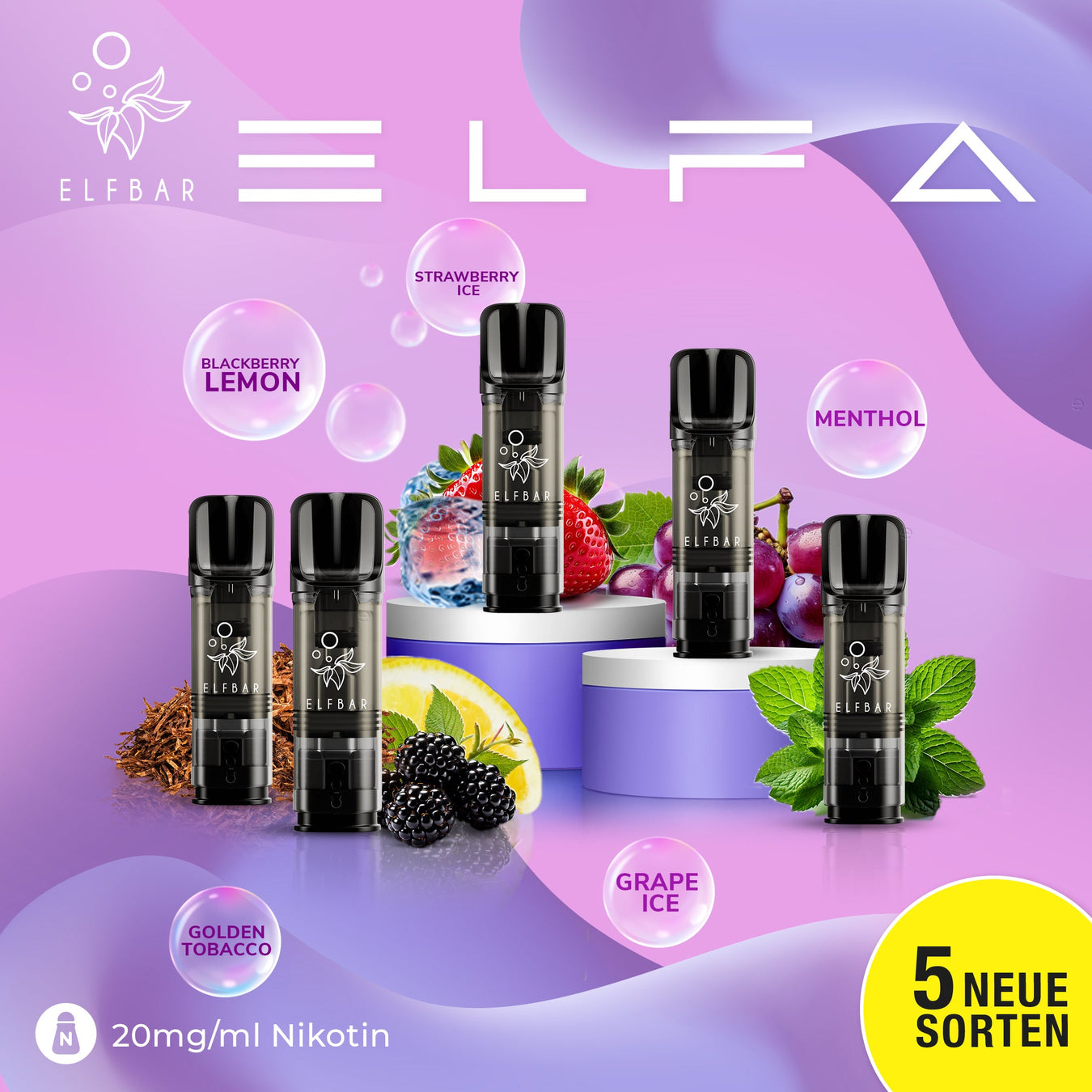
A practical example is pre-filled mesh pods with a 2 ml filling volume, as is the case, for example, with the ELFA Prefilled Pod Apple Peach can be used. Here, the integrated mesh coil ensures that the combination of apple and peach aroma is very present from the very first puff.
8.3 Example 3 – Intense flavor from disposable devices
Anyone on the go as few settings as possible Those who wish to do this often use compact disposable e-cigarettes with an integrated mesh coil. A typical example is the
- 2 ml of nicotine salt liquid with 20 mg/ml
- Integrated mesh coil with optimized performance
- up to approximately 800 moves per device
Here, the coil performance is already so precisely matched to the e-liquid, nicotine strength, and draw activation that users can vape without any fine-tuning. very consistent blueberry aroma receive.
8.4 Example 4 – Flexible setup with adjustable power
Those who want to actively control performance and traction can use a compact basic unit with fixed resistance, but adjustable wattage.
One example is this ELFA MASTER Dusty Pink:
- Power range: 9–12 watts with 1.1-Ω pods and 15–18 watts with 0.8-Ω turbo pods
- Compatible with prefilled and refillable mesh pods
This allows for very precise testing, how the same liquid behaves at 9 vs. 12 watts feels: more or less heat, intensity and amount of vapor – and thus an ideal learning field to better understand the effect of power and coil type on the taste.
9. Step-by-step: How to choose your coil
Finally, here is a compact checklist to help you with your selection.
-
Define train style
- MTL (draw like a classic cigarette) → usually higher resistance, 8–15 W.
- Restrictive DL → slightly lower resistance, 15–25 W.
-
Specify liquid type
- Fruity/sweet/with cooling → Mesh coil preferred.
- Tobacco/not very sweet → classic coil or higher resistance mesh.
-
Clarify consumption priority
- Focus on "maximum flavor" → Mesh accepts slightly higher consumption.
- Focus on "economic efficiency" → conservatively operated wire coils or higher-resistance mesh.
-
Select device type
- Disposable or pre-filled pods → comfort-oriented, mesh often already optimally adjusted.
- Refillable pod/base unit with wattage control → more control, ideal for fine-tuning.
-
Testing fine-tuning
- Start at the lower end of the performance recommendation and increase it gradually.
- Observe at what power output the taste clearest, but still pleasantly cool enough remains.
A more in-depth collection of practical tips on how to get more flavor out of pods of any kind can be found in the guide. More flavor from your pod system.
Key points at a glance
- Mesh coils They offer a larger heating surface, extremely fast response and very clear flavor reproduction – ideal for fruity and sweet liquids, but with higher liquid and battery consumption.
- Classic wire windings They operate somewhat more discreetly and often more economically. They are well suited for tobacco-flavored liquids and users who prefer an unobtrusive everyday setup.
- The proper handling – Priming, appropriate power range, suitable PG/VG ratio – are crucial in determining whether a coil shows its potential.
- Standards such as ISO 20768 and laboratory tests at facilities such as ASL Analytics Service and Dartsch Scientific This helps ensure that coils operate stably and reproducibly within the intended range.
- Those who consistently base their coil choice on Drawing style, liquid type and consumption priority By aligning itself, it finds the right technology without lengthy trial and error.
Note: This article is for informational purposes only and does not replace individual advice. When handling nicotine-containing products, individuals with pre-existing medical conditions or particular sensitivities should consult a medical professional.