Airflow Control at Vape Mods: Perfect vapor as desired
Airflow control in vape mods: Perfect vapor as desired
The airflow control is the throttle of your vape mod. You determine the draw resistance, temperature, noise, and ultimately, the intensity of your e-liquid flavor via the airflow. Advanced pod systems with adjustable airflow and power – such as modern ones – offer even more advanced features.
This guide explains how to technically understand and systematically adjust the airflow of your pods, instead of just turning a ring "by feel." We combine practical heuristics from experienced vapers with the regulatory framework of the EU Tobacco Products Directive (TPD) and the German Tobacco Products Act. The goal: reproducible, safe, and legally compliant settings that perfectly match your vaping style.

1. What Airflow Control technically means
1.1 Airflow, draft resistance and pressure difference
Essentially, the airflow control regulates how much air flows through the atomizer with each puff. Opening the airflow reduces the draw resistance: you inhale more easily, more air flows past the coil, and the vapor becomes cooler and less concentrated. Closing the airflow increases the resistance, and the vapor becomes warmer and denser.
Physically, this is what happens: When you inhale, you create a vacuum. The smaller the opening, the higher the airflow velocity at the coil and the more the aerosol heats up. More air (open airflow) distributes the same power input (watts) over a larger volume – this lowers the temperature per unit of air volume.
1.2 MTL vs. RDL/DTL – why airflow has such different effects
Advanced pod systems now cover several vaping styles:
- MTL (Mouth-to-Lung) – tight draw similar to a classic cigarette, typically with higher resistances (z.B. 1.1 Ω) and moderate power outputs (9–12 W).
- RDL (Restricted Direct Lung) – direct inhalation into the lungs with slightly more open airflow; resistances usually around 0.6–0.8 Ω at 15–25 W.
With MTL (mouth-to-lung) vaping, a slightly restricted airflow creates the "cigarette-like" draw: noticeable resistance, warm, concentrated vapor clouds. With RDL (rear-lung) vaping, the coil needs more air to dissipate the higher wattage; otherwise, the vapor becomes too hot and the coil ages faster.
1.3 Regulated airflow in practice: Pod systems instead of large devices
While classic mods sometimes offer huge airflow slots for high power output, pod systems operating under the EU-TPD regulations use significantly more compact atomizers and a maximum e-liquid capacity of 2 ml per pod. EU Tobacco Products Directive It also limits the nicotine strength to 20 mg/ml.
Besides air supply, energy management is also important: Here you'll learn how to... Maximize battery life can.
For you, this means: Airflow settings must always be considered in the context of... Coil resistance, maximum output power and nicotine strength This should be considered. A pod that works at 0.8 Ω and 18 W will tolerate different airflow positions than a 1.1 Ω pod at 10 W.
2. How airflow, coil, and wattage are related
2.1 The role of the mesh coil in the pod system
Modern pod systems with Mesh coil – that is, flat, grid-like heating elements instead of classic wire windings – generate more even heat and thus more stable aroma development. In our technical article on How Mesh Coils Work It is shown how the enlarged surface area finer control of power and airflow allowed.
Important: Mesh coils are more sensitive to insufficient airflow.Airflow set too tightly at higher power levels leads more quickly to "burnt" food.
2.2 Practical heuristic: Coupling airflow and resistance
Experienced technicians use simple rules of thumb to couple airflow and coil resistance:
- 0.6 Ω Dual-Mesh (RDL): Start with 40–70% open airflow for warm, dense steam.
- 0.8 Ω mesh (RDL/tight MTL): 30–60% open In bench tests, it often delivers the best ratio.
Flavour and temperature. - 1.1 Ω MTL pods: Maintain the airflow 10–30% open for a classic MTL draw.
These ranges are based on experience from everyday scenarios with power outputs between 10 and 25 W. They do not replace manufacturer specifications, but provide you with a structured starting point.
If the device malfunctions, we'll show you solutions to fix it. To fix problems with your disposable vape.
2.3 Fine-tuning wattage for airflow – the “accelerator pedal” principle
A frequently overlooked point: If you significantly open the airflow, you should slightly reduce the power. The following approach has proven effective in practice:
- Start with the Airflow for about half open at the recommended performance average (z.B. 15 W for a 10–18 W pod).
- Open the airflow in 10% increments, if you want a freer train.
- For each larger opening step, you reduce the power by 0.5–1 W.
This keeps the vapor temperature stable, makes the throat hit (the scratching sensation in the throat caused by nicotine and temperature) controllable, and ensures the coil is evenly stressed.
3. Step-by-step: Adjusting your ideal airflow
3.1 Preparation: Check pod, seals and liquid
Before you adjust the airflow, you should ensure your setup is technically sound:
- Insert the pod correctly: Make sure that the pod clicks noticeably into place and that no gaps are visible between the pod and the device.
- Check O-rings and seals: Porous or twisted seals lead to false air leaks and distort your airflow setting.
- Liquid level: Fill pods to just below the top of the airflow channel. Overfilling increases the risk of spitback (hot liquid splashing into the mouth).
- prime coil: After filling, allow the pod to rest for 5-10 minutes so that the cotton can become fully saturated.
Many problems that appear to be caused by "incorrect airflow" actually arise from poorly fitting pods or liquid residue in the mouthpiece – a topic also discussed in forums like the E-smoking forum reappears again and again.
3.2 Basic settings for different scenarios
Use the following table as a starting point. It is based on typical pod system configurations in the 9–30 W range.
| scenario | Coil resistance | Nicotine type | Starting power | Airflow starting position |
|---|---|---|---|---|
| Classic MTL, tight draw | 1.1 Ω | Nicotine salt up to 20 mg/ml | 9–11 W | 10–20% open |
| Gentle MTL/mild RDL | 0.8 Ω | Nicotine salt 10-20 mg/ml or freebase 6-12 mg/ml | 13–16 W | 30–40% open |
| RDL, heavy clouds | 0.6 Ω Dual-Mesh | Freebase 3–6 mg/ml | 18–25 W | 40–60% open |
| Aroma test/“Flavor Chasing” | 0.8 Ω | Freebase 3–6 mg/ml | 15–18 W | 20–50% open |
These values are deliberately chosen conservatively so that you work from "too mild" towards "intense", rather than going the other way and into a range where the steam becomes too hot or harsh.
3.3 Fine-tuning in 4 steps
Once the basic settings are in place, you can optimize them in a structured process:
- Assessing tensile resistance: If the draw feels too heavy, open the airflow in 10% increments; if it is too light, close it accordingly.
- Check temperature: If the vapor becomes uncomfortably hot, reduce the power by 0.5–1 W or slightly open the airflow. If the vapor is too cool and flat, close the airflow slightly or moderately increase the power.
-
Flavour check: If flavors seem "dull", there is often too little air involved; if it becomes harsh and unpleasant, there is usually too much power with too little air involved. - Observe stability: Occur after several
puffs Spitback or slight leaks may be caused by an overly open airflow combined with a high liquid level.
After 10–15
4. Typical mistakes with airflow control – and how to avoid them
4.1 Mistake 1: Airflow fully open with high nicotine content
A common mistake: The airflow is fully opened while simultaneously using high-dose nicotine salt (z.B. 20 mg/ml). In this combination, many users report severe coughing fits and pressure in the head.
The reason: The open airflow allows you to inhale larger amounts of vapor in a shorter time, and therefore more nicotine per puff. EU-TPD While it limits the concentration to 20 mg/ml, it doesn't limit the volume per puff. Those who turn the airflow and power up to maximum can therefore inhale a dose that is unusual for their body.
Solution:
- With high nicotine salt strengths, airflow should be in the range of 10–40% hold.
- If you want "more vapor", it's better to switch to pods with a lower nicotine content.
4.2 Error 2: Airflow too restricted with mesh and low power
On the other hand, an excessively restricted airflow in mesh coils often leads to a "stifled" vapor: it sounds muffled, sometimes fizzy, and after a few
Solution:
- For 0.8-Ω mesh coils, rarely below 30% Open the airflow opening as long as the power output is within the specified range.
- If you prefer a very tight pull, significantly reduce the power (z.B. (from 16 to 12 W) and observe the steam development.
4.3 Mistake 3: Using airflow as a "volume control"
Many users simply adjust the airflow based on the noise level – they want it to be as quiet as possible. While a quiet draw is pleasant, it's not a reliable indicator of quality. Conversely, an overly restricted airflow might be quieter, but it ruins heat distribution and flavor development.
It is better to first look for
4.4 Myth: "More airflow = automatically more safety"
A common misconception is that a fully open airflow "protects" the coil and automatically makes the vapor more tolerable. In reality, safety always depends on the interplay of:
- adequate performance
- suitable nicotine content,
- suitable draft volume.
A completely open airflow at excessively high wattage can even lead to users unknowingly inhaling more nicotine than intended. Official bodies such as the Federal Institute for Risk Assessment (BfR) It should be emphasized that nicotine absorption varies greatly from person to person. Therefore, it is advisable to adjust airflow settings gradually and pay attention to bodily signals.
5. Airflow depending on nicotine, PG/VG and device type
5.1 Nicotine salt vs. freebase – how the throat hit changes
Nicotine salt e-liquids are designed for a smoother inhalation experience at the same nicotine strength. In practice, this means that many vapers can tolerate slightly higher concentrations of nicotine salt without experiencing a harsh throat hit. At the same time, an open airflow promotes larger vapor production per puff.
Therefore, the following applies to the combination of nicotine salt and adjustable airflow:
- High concentration (z.B. 20 mg/ml) → rather restrictive airflow, moderate performance.
- Medium concentration (10–12 mg/ml) → Airflow open in the middle; this allows for good compromises between draft-free operation and control.
5.2 PG/VG ratio and airflow
The mixing ratio of PG (propylene glycol) and VG (vegetable glycerin) Determines viscosity, vapor production, and throat hit. See our detailed guide to... PG/VG ratio in pod systems It explains why pod systems often work more reliably with thinner liquids (higher PG content).
In the context of airflow, this means:
- Higher VG content (z.B. 70 VG/30 PG): It is thicker, requires more power and air so that the coil does not "drown".
- Higher PG content (50/50 or lower): The fluid flows in faster, which can lead to increased spitback if the airflow is too open and the power output is high.
A tried and tested strategy is to open the airflow a little wider when using high-VG liquids and to operate the power in the upper third of the coil area in order to achieve clean vaporization.
5.3 Device categories: Compact pods vs. high-performance kits
Larger battery carriers with output powers of 30 W and above can handle significantly more open airflow settings because they are designed for higher airflow rates. Pocket-friendly, MTL-oriented pod systems with integrated batteries around 800–1,000 mAh, on the other hand, are clearly designed for more restrictive airflow and more efficient nicotine delivery.
An example of a powerful yet compact pod system is the
6. Specific airflow setups for ELFA - and ELFX -systems
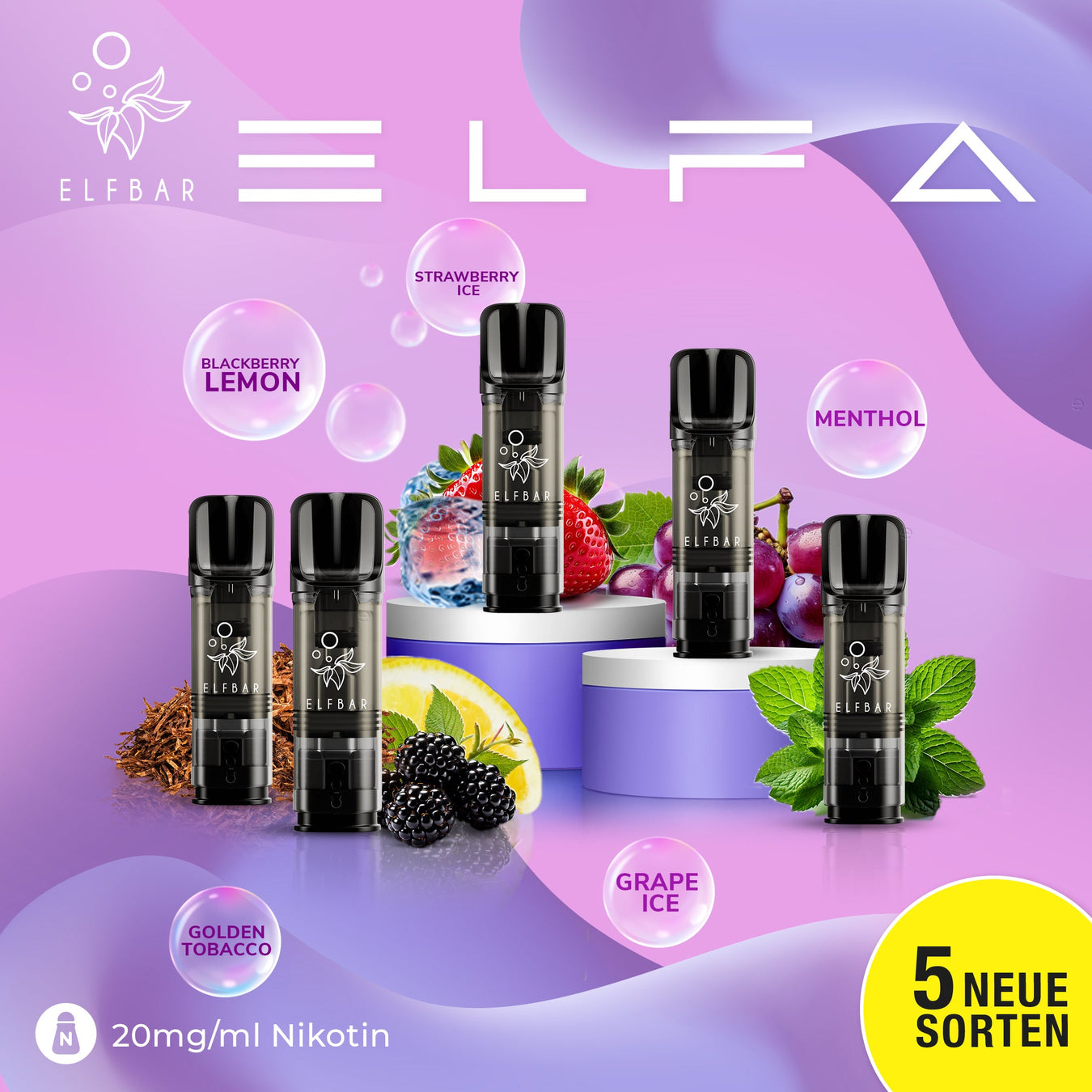
6.1 MTL setup with ELFA -Pods and nicotine salt
For users switching from traditional cigarettes and who prefer a similar draw, a setup with 1.1-ohm pods and nicotine salt liquids is recommended. Prefilled pods with 20 mg/ml are available. EU-TPD The upper limit, but with the correct airflow setting they deliver a smooth, controlled draw.
A typical configuration might look like this:
- Pod type: z.B. a pre-filled 1.1-Ω pod like the
ELFA Prefilled Pod Berry Snoow with 20 mg/ml. - Performance at the device: 9–11 weeks
- Airflow: 10–25% open, depending on how closely you want the draw resistance to resemble that of a cigarette.
With this setting, the draw is deliberately tight, the vapor is warm, and the nicotine delivery per draw is relatively constant.
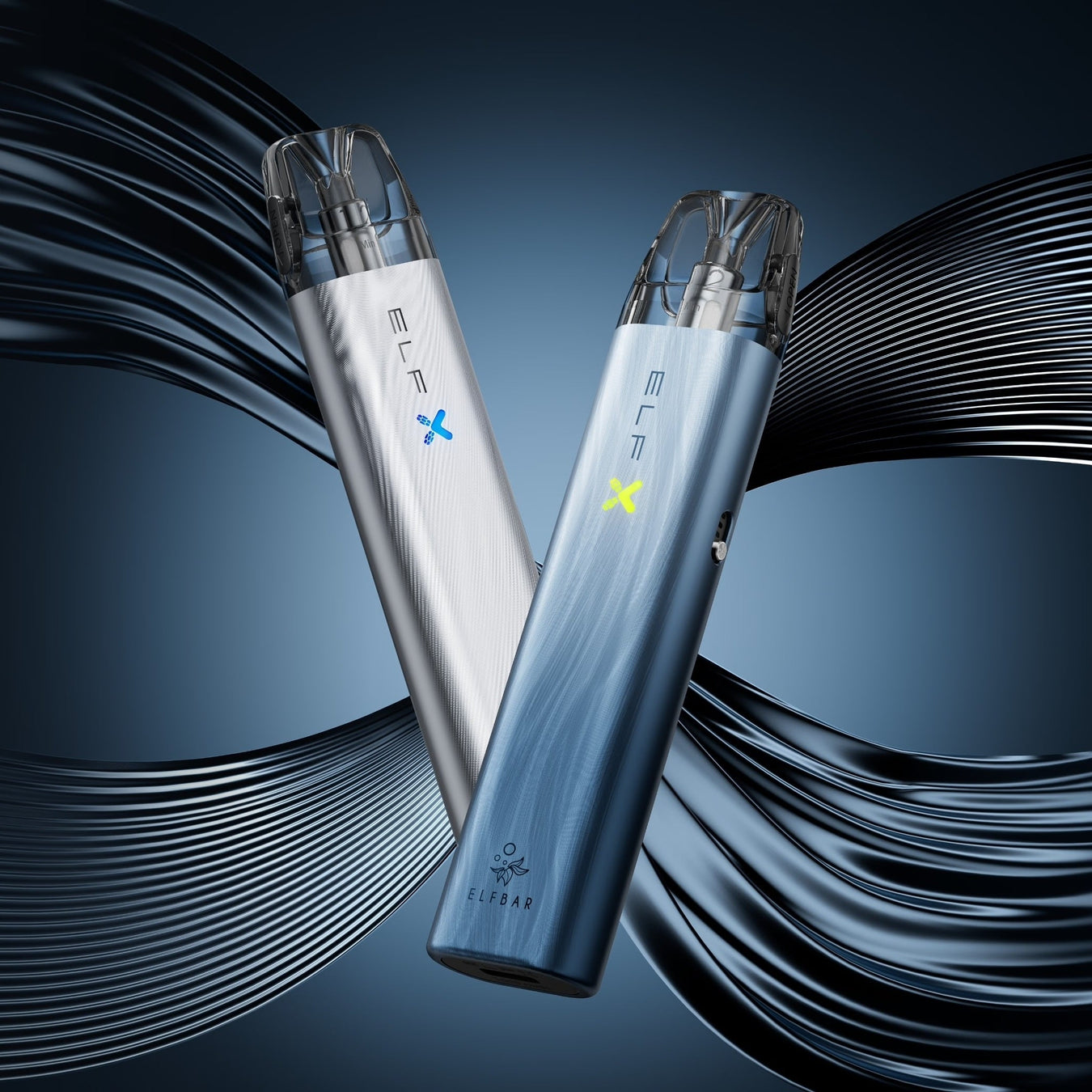
6.2 RDL setup with ELFX Dual-Mesh Pods
For experienced users who want more steam volume and intense flavor.
Tried and tested settings include:
- Pod type: 0.6-Ω dual mesh pod in
ELFX -System. - Performance: 18–24 W, depending on the liquid (with a higher VG content, more likely at the higher end of the range).
- Airflow: 40–65% open for warm, but not overheated, steam.
- Liquid: Preferably use freebase nicotine in the range of 3–6 mg/ml to keep the nicotine kick controllable despite a higher vapor volume.
6.3 ELFA MASTER Clearly read airflow and power readings
Devices with a display offer the advantage that you can save your fine-tuning settings reproducibly or read them at any time.
- 9–12 W for 1.1-Ω-
ELFA -Pods (MTL). - 15–18 W for 0.8-Ω turbo pods (strong MTL or light RDL).
In combination with a finely adjustable airflow, you can save several profiles – for example, a tight MTL setup for on the go and a slightly more open setup for longer evening sessions.
7. Maintenance, leakage prevention and airflow fine-tuning
7.1 Regular cleaning for stable airflow
Deposits in the mouthpiece and airflow slots noticeably alter the airflow. Cleaning is recommended. monthly cleaning:
- Rinse the mouthpiece with warm water and allow it to dry completely.
- Carefully clean the airflow slots with a dry cotton swab.
- Remove any remaining liquid from the channel between the pod and the device using a cloth.
Practical observations show that such cleaning extends the time between coil changes by about 10–20%, because the airflow remains stable and the coil does not constantly operate in a “damp environment”.
7.2 Avoid spitback and leakage
Spitback – small, hot droplets of liquid in the mouth – often occurs when too much Liquid in the evaporator chamber. Common causes are:
- Overcrowded pods.
- Excessive "priming" (too many
puffs (without performance). - Very open airflow for thin liquids.
Practical countermeasures:
- Keep the fill level consistently below the upper airflow channels.
- If spitback occurs, adjust airflow. 10–20% close, Slightly reduce power and do some short, gentle steps.
puffs take until the system stabilizes.
7.3 When to change pods or coils?
Even the best airflow setting can't save a worn-out pod. Typical signs that a replacement is needed are:
- Significantly flatter
Flavour despite unchanged airflow. - Increasing leakage at the airflow slots.
- Persistent scratching noise that cannot be resolved by adjusting power and airflow.
In everyday use, many users show that after about 10 fillings Depending on wattage, e-liquid, and puff length, replacing a refillable pod becomes necessary. Those who use very sweet e-liquids or frequently vape at the maximum wattage will need to replace their pods sooner.
8. Legal framework, product safety and airflow
8.1 Why legal devices are important – also for airflow
The German market is subject to the Tobacco Products Act (TabakerzG) and the EU-TPD Clear guidelines exist regarding liquid quantity, nicotine strength, and product labeling. Devices that comply with these guidelines are designed for a specific power and airflow range.
In industry reports of Association of e-cigarette retailers (VdeH) The growth of the black market is regularly highlighted. Products offered there often do not adhere to fill quantity and nicotine limits and their airflow and performance architecture is not calibrated for the local legal framework.
For you, this means: Anyone who relies on officially registered sites, listed in databases such as the... EAR Foundation Users of guided devices can assume that airflow, power and liquid volume are technically coordinated.
8.2 Youth and health protection: Airflow as a control mechanism for nicotine absorption
Studies like the DEBRA study The data shows that e-cigarettes in Germany are predominantly used by adults, often in the context of switching from traditional cigarettes. At the same time, the data also indicates that... Federal Institute for Risk Assessment pointing out that while e-cigarettes have a lower potential for harm than tobacco smoke, they are not risk-free.
Airflow settings are an important tool in this context:
- More open airflow → larger vapor volumes → potentially higher nicotine intake per unit of time.
- Narrower airflow → smaller
puffs , but more focused.
By consciously choosing moderate airflow and power settings, you can control your intake and avoid typical overdose symptoms such as nausea or headaches. Those switching to vaping, especially those with pre-existing medical conditions, should seek medical advice beforehand.
9. Pro Tip: Test systematically instead of constantly "turning things around".
Many advanced users constantly adjust airflow and power – often without a clear goal.A systematic approach is more effective:
- Change one variable per day: Either performance or airflow – never both at the same time.
- Keep a train log: Briefly note which power/airflow setting you are using and how
Flavour , temperature and throat hit are perceived. - Save favorites: If a combination is particularly convincing, highlight it clearly (z.B. 14.5 W/35% Airflow) and return there if in doubt.
In practice, it turns out that those who proceed in this way will find 1-2 "sweet spot" settings within a few days, which can then be used stably for weeks.
10 Key Takeaways on Airflow Control
- Airflow is more than just "open or closed".: It determines the draw resistance, temperature, and intensity of your vapor.
- Always think in terms of three elements: Airflow, power (watts) and nicotine strength belong together and should be coordinated.
- Choose conservative starting values: Start with medium airflow and medium power, gradually work your way up.
- Avoid typical mistakes: Fully open airflow with nicotine salts and too narrow airflow with mesh coils often lead to coughing, spitback, or a burnt taste.
Flavour . - Regular maintenance: Clean airflow slots, correctly seated pods and timely coil replacements are prerequisites for any fine-tuning.
- Use legally compliant devices: This is the only way to ensure that airflow, power and liquid volume are properly balanced.
FAQ: Frequently asked questions about airflow control in pod systems
How can I tell if my airflow is too open?
If you cough heavily despite moderate power output, the steam is very cool, and you cough a lot in a short time
Can I reduce liquid consumption with a very narrow airflow?
Only to a limited extent. While the
Why does my e-liquid suddenly taste flat, even though I haven't changed anything?
Often the coil or pod has aged. After about 10 refills, performance noticeably decreases. Sometimes deposits have also formed in the airflow, altering the airflow.
Is silent airflow a sign of quality?
Not necessarily. A quiet train is pleasant, but says little about quality. Consistency is more important.
What role does the PG/VG ratio play in airflow adjustment?
Thick, VG-heavy liquids usually benefit from a slightly more open airflow and higher power, while thin, PG-heavy liquids tend to benefit from a slightly more restrictive airflow to avoid spitback.
Notice
This article is for informational purposes only and does not replace medical advice. E-cigarettes are intended for adult users. Individuals with pre-existing medical conditions, especially cardiovascular or pulmonary diseases, should seek medical advice before using e-cigarettes. Use nicotine-containing products responsibly and keep them out of the reach of children and adolescents.